Generation of laser-induced periodic surface structuring (LIPSS) is a fast and low-cost method for nanostructure formation. Nano-ripples can act as a template for metal nanoparticle deposition, which exhibits plasmonic properties. Layer of nanoparticles deposited on a template shows enhancement of Raman scattering signal and could be used to detect low-concentration analyte molecule.
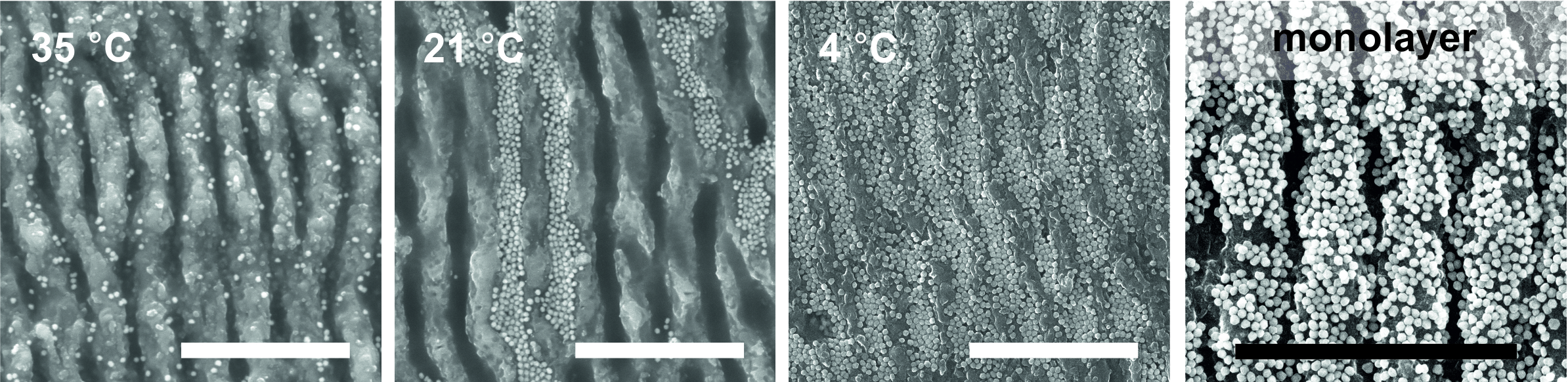
In this study, surface of crystalline silicon was structured with femtosecond laser pulses (Pharos) to induce LIPSS on the surface that alters wetting properties of the surface. Later on chemically synthesized silver nanoparticles of 100 nm diameter were deposited on the Si LIPSS by drop evaporation and monolayer formation methods. In the drop evaporation method, a drop of colloidal solution was dispersed on periodic structures and dried at 3 different temperatures: 35 °C, 21 °C, and 4 °C. Furthermore, a monolayer of nanoparticles was created in the water-hexane interface and later on transferred onto the structures by capillary flow. SEM surface analysis showed that deposition of nanoparticles strongly depends on the temperature during the process. At 35 °C nanoparticles were deposited randomly all over the surface, at 21 °C nanoparticles started to follow the pattern but grooves were not filled completely, and at 4 °C all the grooves were filled with nanoparticles. A deposition from a water-hexane interface was most effective as nanoparticles covered a surface of periodic structures as a closely packed layer (see Fig. 1).