In the field of ultrafast optics, femtosecond pulsed lasers are pivotal due to their extensive applications in science and technology. The quest for shorter laser pulses is driven by the need for higher temporal resolution, greater peak power and precision in applications. Nonlinear phenomena such as: spectral broadening and post-compression are commonly used to achieve shorter pulses. Typically, multi-pass configurations are employed to achieve significant spectral broadening leading to losses and large delays with respect to the laser output [1]. Benefits of such complex systems are: high compression ratio and preserved beam quality. Commercial systems emerged recently as well [2].
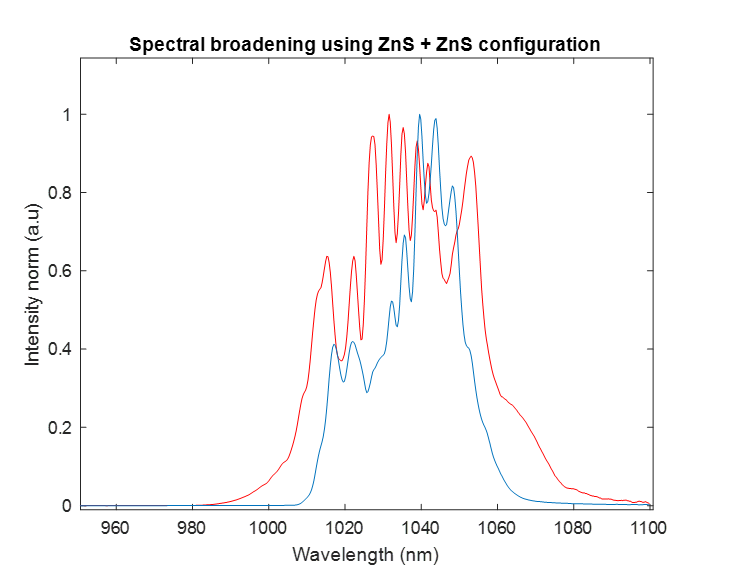
We investigate prospects of compression with femtosecond Yb:KGW 76 MHz laser oscillator [3] low energy 210 nJ pulse with relatively low losses. Two setups for compression investigated, intermediate single-pass and double-pass through a nonlinear material – ZnS, possessing large nonlinearity when compared to most optical materials. First, self-phase modulation is achieved using a very high intensity laser beam and a nonlinear material so that the spectrum is broadened. Later post-compression is applied using Gires-Tournois mirrors with negative group velocity dispersion to achieve pulses that are shorter and have higher peak power than the original. The resulting and primary spectrum of the laser oscillator are shown in figure 1. This study shows that ZnS, low bandgap optical material, can be successfully used in the high average power multi-pass setup for spectrum broadening without damage.