
Terahertz (THz) images are often plagued with the problem of low spatial resolution due to the limited hardware capabilities and long imaging times. To address this challenge, various image processing methods are used. Recent advancements in machine learning models have yielded notable breakthroughs in addressing computer vision tasks, including their application in the domain of terahertz (THz) imaging. The goal of this work is to develop several neural network models aimed at enhancing resolution and bringing back the missing details in low-resolution terahertz (THz) images. To achieve this task, three convolutional neural network (CNN) generative adversial (GAN) models – SRGAN, SRResNet and DeblurGan were trained on simulated data and reached PSNR values of 21,515 dB, 19,271 dB and 20,657 dB respectively. On real THz image data SRGAN and DeblurGan performed similarly and did manage to restore certain details from the test images, performing better than SRResNet model. In the analysis of actual terahertz (THz) image data, SRGAN and DeblurGan exhibited comparable performance, effectively restoring specific details from the test images, demonstrating better performance than SRResNet model. However, these models tend to over-restore details and introduce severe artifacts in the final image due to their extreme sensitive to noise, because of the strong mapping ability of the CNN type networks. 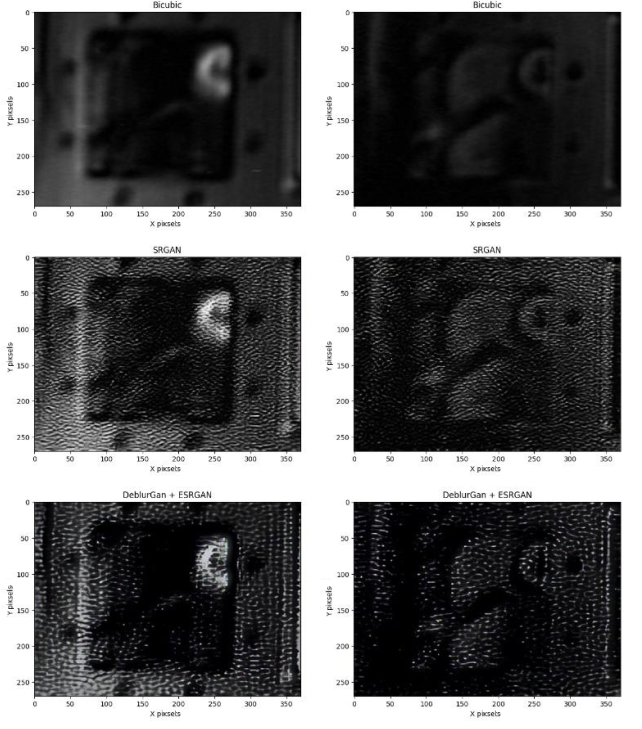
PROCESSING OF THZ IMAGES USING DIFFERENT NEURAL NETWORK MODELS
Ugnė Šilingaitė1, 2, Ignas Grigelionis2
1 Vilnius University
2 Center for Physical Sciences and Technology (FTMC)
Fig. 1. Performance of different neural networks, using low resolution THz image as an input.