There is an increasing interest in the research of protein aggregation and the formation of amyloid structures in various scientific fields. This heightened interest is driven by the connection between amyloid deposition and numerous serious medical conditions, including Alzheimer and Parkinson diseases, type II diabetes, and many systemic amyloidoses. In today’s world, these disorders pose a major threat to human health and well-being, so more detailed research is needed [1]. A growing number of studies have described a variety of inhibitors targeting self-assembled amyloidogenic proteins, and some of these are presently undergoing clinical trials. These inhibitors can be categorized into small molecules, short peptides, and antibodies [2].
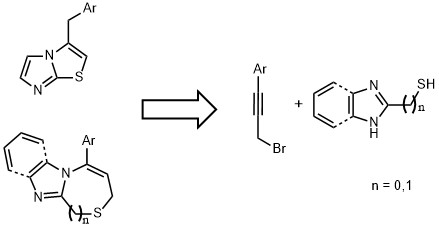
Recent preliminary studies of imidazothiazines synthesized in our laboratory have shown potential inhibition of amyloid aggregation. Consequently, targeted synthesis of imidazothiazoles, imidazothiazines and imidazothiazepines from aryl propargylic bromides and the corresponding imidazoles for inhibition of amyloid aggregation is in progress. A more detailed analysis of the synthesis will be discussed during the presentation. Studies are being carried out on insulin, a commonly used protein to study the formation of amyloid fibrils [3], and on alpha-synuclein, a Parkinson’s disease-related protein [4].