
Near-infrared (NIR) triplet-sensitized Z-E photoswitching of azobenzene derivatives is a novel strategy of molecular isomerization with many promising applications including solar energy storage, photoactuation, and light-activated drug release. [1,2] The Z-E photoswitching of azobenzene derivatives is usually performed only via blue-green excitation, however, it implicates many possible implementations due to the low penetration depth of blue-green light. Therefore, a novel approach of direct triplet sensitization via NIR excitation shifting the action spectrum to the phototherapeutic region (650 nm to 850 nm) is regarded as a promising and viable alternative.
In this work, we generalize the approach for Z-E conversion of functionalized azobenzene chromophores (Azo-H, Azo-EH and Azo-MM) via NIR triplet sensitization by designing different photoswitch:sensitizer systems co-assembled within a liquid surfactant–protein in a bio-sustainable gelatin matrix. All azobenzene derivatives demonstrated Z-E photoisomerization upon excitation with 850 nm light via direct triplet sensitization despite a large endothermic triplet energy gap.
Herein, we also report the first example of triplet-sensitized Z-E photoisomerization of azobenzene derivatives with NIR light (850 nm) in aqueous biomimetic conditions at low photon fluence of 2.62 mW cm\(^{-2}\) by employing liquid and solid azobenzene derivatives in combination with palladium naphthalocyanine (PdNc), zinc phthalocyanine (ZnPc) and bacteriochlorin (BCl) sensitizers absorbing at 830 nm, 780 nm, and 730 nm, respectively. The biomimetic conditions are comprised of photoswitch:sensitizer ensembles trapped in a PF-127 artificial micellar membrane coated with a calcium-alginate hydrogel framework and placed below the 8 mm animal skin layer. Viable NIR triplet sensitized photoswitching is shown upon the 850 nm LED excitation as 10 consecutive cycles of conversion were observed with the action spectrum shift of 1.35 eV. Therefore, the developed approach provides a solid platform for in vivo photoactivation at 2-4 orders of magnitude lower photon fluences of NIR excitation compared to two photon abosorption (2PA), excited state absorption (ESA), and triplet fusion upconversion (TF-UC). 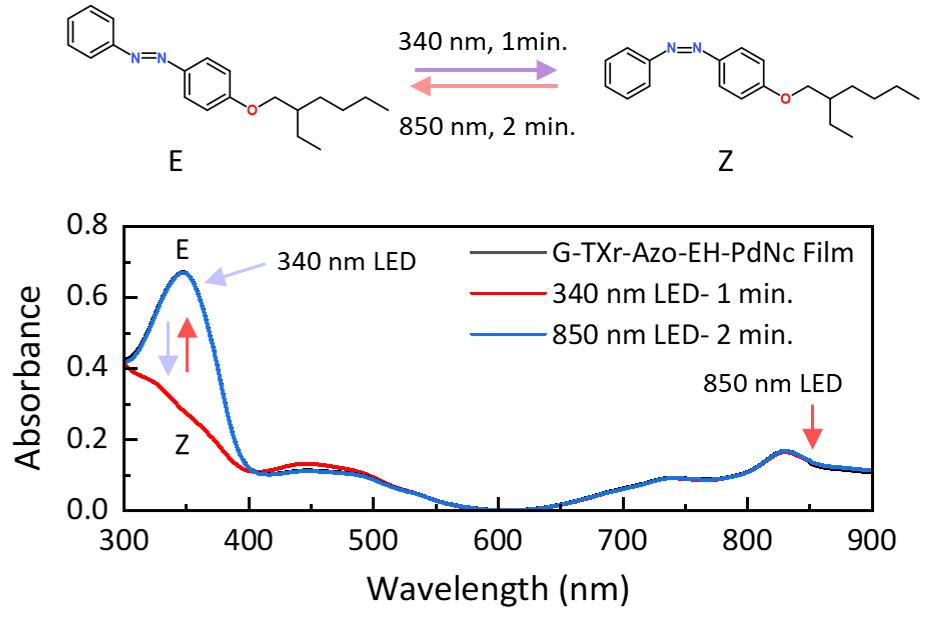
NEAR-INFRARED SENSITIZED DEEP TISSUE PHOTOACTIVATION OF AZOBENZENE IN BIOMIMETIC CONDITIONS AT LOW PHOTON FLUENCES
Lukas Naimovicius1, 2, 3, Ekin Opar4, Justas Lekavicius3, Edvinas Radiunas3, Helen Holzel5, Edvinas Orentas3, Karolis Kazlauskas3, Pau Gorostiza4, Pankaj Bharmoria2, Kasper MothPoulsen5, 6, 7
1 Department of Chemistry and Biochemistry, University of California - San Diego
2 Institute of Materials Science of Barcelona (ICMAB-CSIC)
3 Institute of Photonics and Nanotechnology, Vilnius University
4 Institute for Bioengineering of Catalonia (IBEC)
5 Department of Chemical Engineering, Universitat Politecnica de Catalunya (UPC)
6 Catalan Institution for Research and Advanced Studies, ICREA
7 Department of Chemistry and Chemical Engineering, Chalmers University of Technology
[1] Y. Wang et al., Nat. Rev. Mater. 2017, 2, 17020
[2] Y. Sasaki et al., Angew. Chem. Int. Ed., 2019, 58, 17827