LAMMPS AS A LIBRARY FOR THE THEORETICAL STUDY OF THE ROLE OF PHONONS IN ULTRAFAST DEMAGNETIZATION
Wojciech Marciniak1, 2, 3, Joanna Marciniak3, Jan Rusz2
1 Institute of Physics, Faculty of Materials Engineering and Technical Physics, Poznań University of Technology, Piotrowo 3, 61-138 Poznań, Poland
2 Department of Physics and Astronomy, Uppsala University, P.O. Box 516, 75120 Uppsala, Sweden
3 Institute of Molecular Physics, Polish Academy of Sciences, M. Smoluchowskiego 17, 60-179 Poznań, Poland
Ultrafast modification of the magnetism of materials by laser pulses has attracted significant attention since its discovery in 1996 [1] because of its potential applications in computing and data storage. The process involving the transfer of angular momentum between electrons, phonons, and magnons is a complex interaction of light and matter, and it is still only partly understood [2].
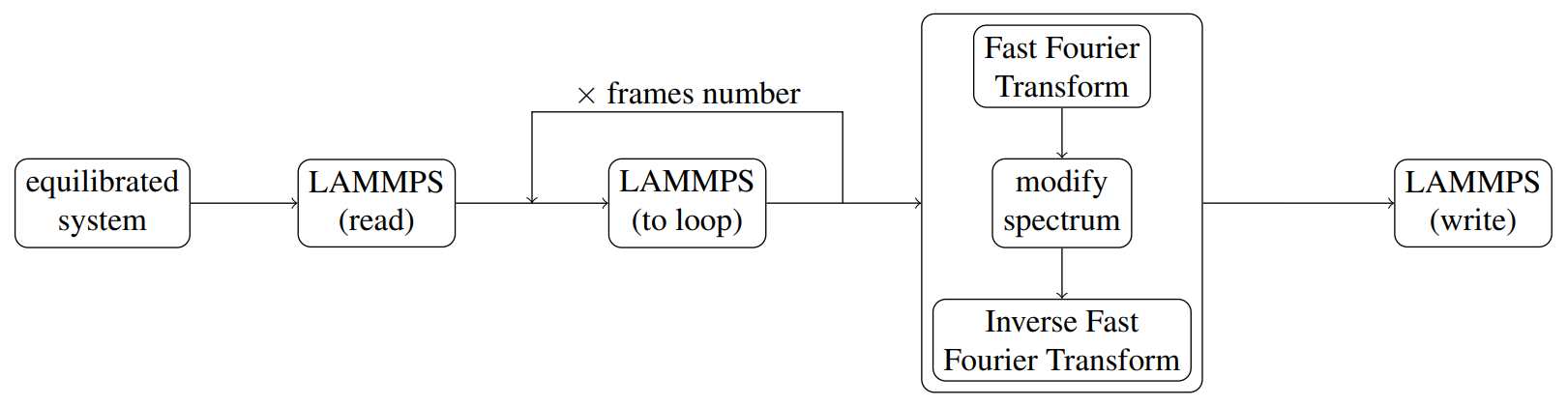
To allow us to investigate phonons evolution after a laser pulse, we implemented a simple approximation to modify molecular dynamics trajectory to enhance specific vibration modes. Using LAMMPS as a library feature [3], we created a framework that allows LAMMPS to handle data input, generate snapshots to be processed by our method and output the modified trajectory.
Fig. 1. A simplified schematic of the applied workflow.
Using the developed framework, we will study how phonons can contribute to re-establishing the equilibrium by carrying away the excess heat and angular momentum. We will evaluate the evolution of lattice vibrations from high temperatures of selected vibration modes towards an equilibrium using SNAP machine-learning interatomic potential (ML-IAP) [4]. Snapshots of the molecular dynamics trajectories will allow us to predict changes in the diffraction patterns and in electron energy loss spectra (EELS) in a time-resolved way [5,6].
Acknowledgments: W.M. wants to acknowledge the financial support of the Polish National Agency for Academic Exchange under the decision BPN/BEK/2022/1/00179/DEC/1. JR acknowledges the support of the Swedish Research Council, Olle Engkvist’s Foundation, and Knut and Alice Wallenberg Foundation for financial support. The simulations were enabled by resources provided by the National Academic Infrastructure for Supercomputing in Sweden (NAISS) at NSC Centre, partially funded by the Swedish Research Council through grant agreement no. 2022-06725.
[1] Beaurepaire, E., et al. Ultrafast spin dynamics in ferromagnetic nickel. Physical Review Letters, 76(22), 4250.
[2] Fähnle, M., et al. (2018). Review of ultrafast demagnetization after femtosecond laser pulses: a complex interaction of light with quantum matter. Am. J. Mod. Phys, 7(2), 68-74.
[3] Thompson, A. P., et al. (2022). LAMMPS – a flexible simulation tool for particle-based materials modeling at the atomic, meso, and continuum scales. Computer Physics Communications, 271, 108171.
[4] Thompson, A. P., et al. Spectral neighbor analysis method for automated generation of quantum-accurate interatomic potentials. Journal of Computational Physics, 285, 316-330.
[5] Zeiger, P. M., and Rusz, J. (2020). Efficient and versatile model for vibrational STEM-EELS. Physical Review Letters, 124(2), 025501.
[6] Tauchert, S. R., et al. (2022). Polarized phonons carry angular momentum in ultrafast demagnetization. Nature, 602(7895), 73-77.