
Hydrogen bonds have a significant effect on the properties of small molecules and macromolecules. In trying to understand complex systems quite often model studies of small molecule systems are used. The properties of hydrogen bonds have been an object of study for many decades but there are still many unanswered questions regarding the structure of such systems and the hydrogen bonds that form between these molecules. Findings show that the first three homologous series of carboxylic acids can form at least two types of dimers [1]. Most of the research regarding higher series of carboxylic acids suggests that only cyclical dimers can form in these acids.
The method of low temperature matrix isolation allows for the isolation of molecules from interacting with their surroundings by placing them in crystals made up of inert gas molecules. The infrared spectra of these types of samples have very narrow spectrum lines which allow for identification of different molecule structures.
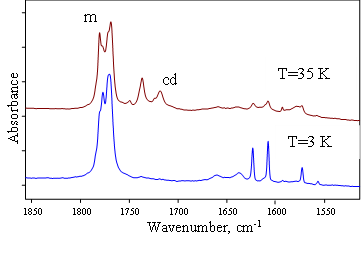
In the picture we can see an infrared absorption spectrum in the region of C=O stretching and O-H deformational vibrations of caproic acid (hexanoic acid CH3(CH2)4COOH) isolated in an argon matrix. When the sample is at a temperature of 3k in the region between 1800-1750 cm\(^{-1}\) of the spectre a wide, structured line is visible which is attributed to C=O group stretching vibrations of the caproic acid monomers. Based on the shape of this line and how it evolves with temperature an assumption can be made that during the experiment we are observing more than one type of monomer in the sample. The quantum chemistry calculations also confirm the possibility that at least two conformers of similar energy levels can exist.
Additional spectral lines that are observed at 1749 cm\(^{-1}\) and 1724 cm\(^{-1}\) cannot be explained by cyclical dimers or water and acid complexes so it can be assumed that in a low temperature inert argon environment low amounts of non cyclical caproic acid dimers also form. While performing annealing experiments the spectral line component which was allocated to higher frequency monomers was shrinking faster than the lower frequency component. Based on the calculation results the higher frequency monomer spectral line part is linked with the molecular structure of the caproic acid in which the carboxylic group is not in one plane with the aliphatic chains plane.
Keywords: Matrix isolation, carboxylic acid, IR spectroscopy.