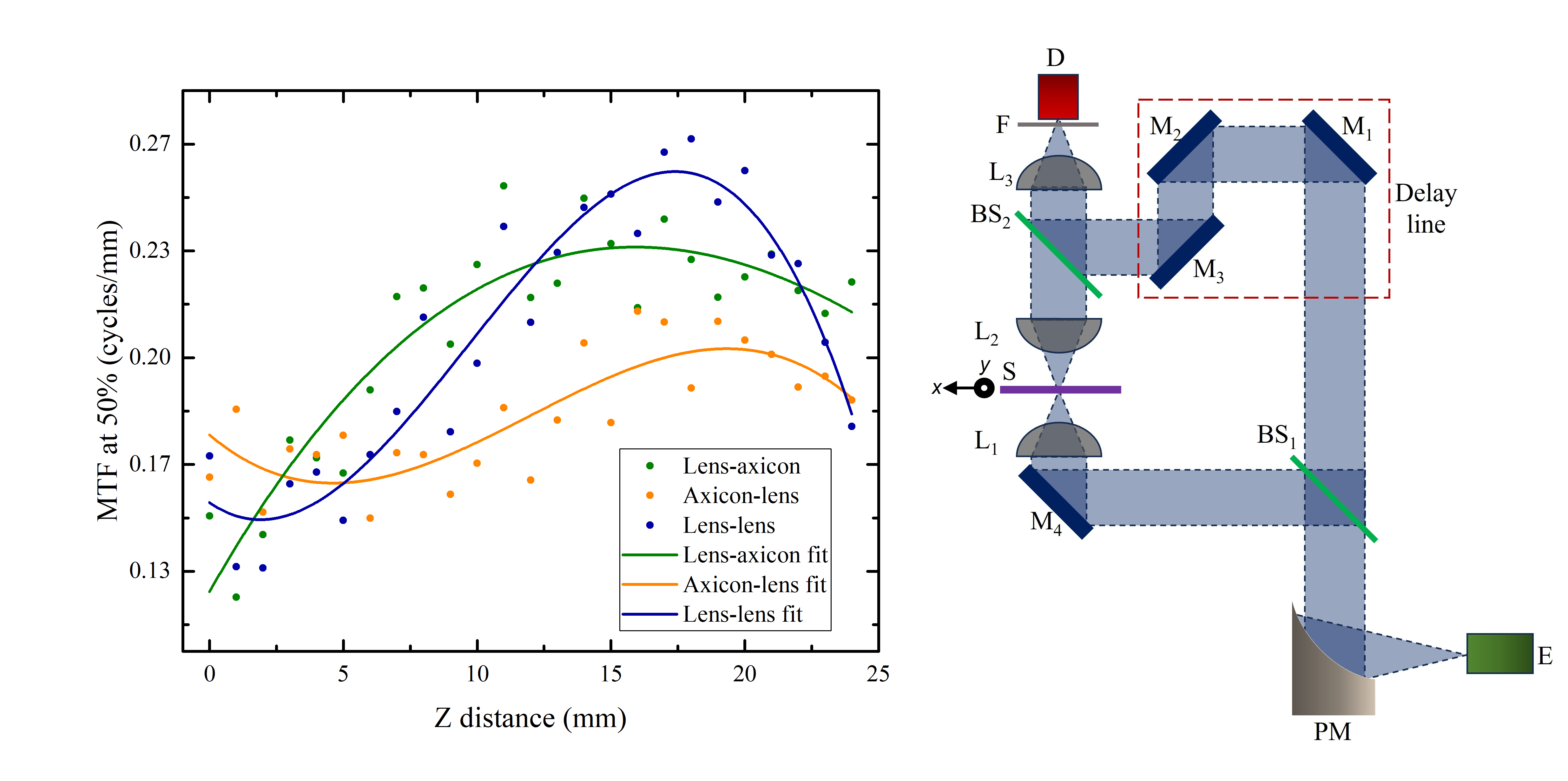
Optical imaging systems are convenient for commercial and scientific interests, finding applications in medicine, security, material analysis, and quality control[1]. While these systems are usually associated with using high-energy radiation (X-ray), leading to obvious disadvantages like ionizing effects and high costs. Terahertz imaging is a perfect solution for imaging system safety since it employs non destructive radiation, which can still penetrate most dielectrics. To achieve even better results interference based coherent imaging (homodyne detection) can be employed.
The objective of this study is to analyze optical component arrangement in THz homodyne imaging systems, with a focus on Gaussian and Bessel axicon lenses [Fig. 1]. These lenses were systematically altered in positions for the imaging system. Modulation transfer function (MTF) was evaluated along optical axis to obtain information about resolution of the imaging system. Contrast information was then utilized in order to obtain best possible conditions for highest resolution imaging on low absorption objects such as thin paper layers or even graphene.
The coherent imaging approach proved to be more effective, since little changes in absorption were depicted more accurately. Obtained results lead to conclusion, that lens types and positions matter in context of terahertz imaging. This research can be further expanded by using even more different types and compositions of lenses, employing non-paraxial optics and forming structured light[2].