Laser-based glass welding offers great mechanical strength and increased longevity of the joint structures but, unlike traditional bonding techniques, does not suffer from creep, out-gassing, and aging [1]. Furthermore, it is a flexible and highly localized process that does not require an intermediate layer for the welding [1]. Ultrashort laser welding relies on nonlinear absorption, which prevents excessive heating of the surrounding material by confining the heat within a localized melt zone [1,2,3]. While welding of optical-contact glasses achieves the highest welding strength, it is difficult to meet the requirements for the optical contact, especially across a large area, even after polishing and cleaning [4,5]. For this reason, the development of laser welding of non-optical contact glasses attracted much attention.
In this work, multi-scan welding of two non-optical soda-lime glasses of 1 mm thickness with a pre-existing gap of 5-6 um was performed with an ultrashort laser in single-shot pulses and MHz bursts. The laser radiation wavelength was 1064nm, pulse duration was 10 ps and 100kHz pulse repetition rate. Laser power, pulse repetition rate, focal position, marking speed, hatch distance, and number of pulses in a burst were optimized. After the welding, a longitudinal tensile test was performed to evaluate welding strength. Additionally, the quality of welds was evaluated via optical micrographs and light transmission measurements.
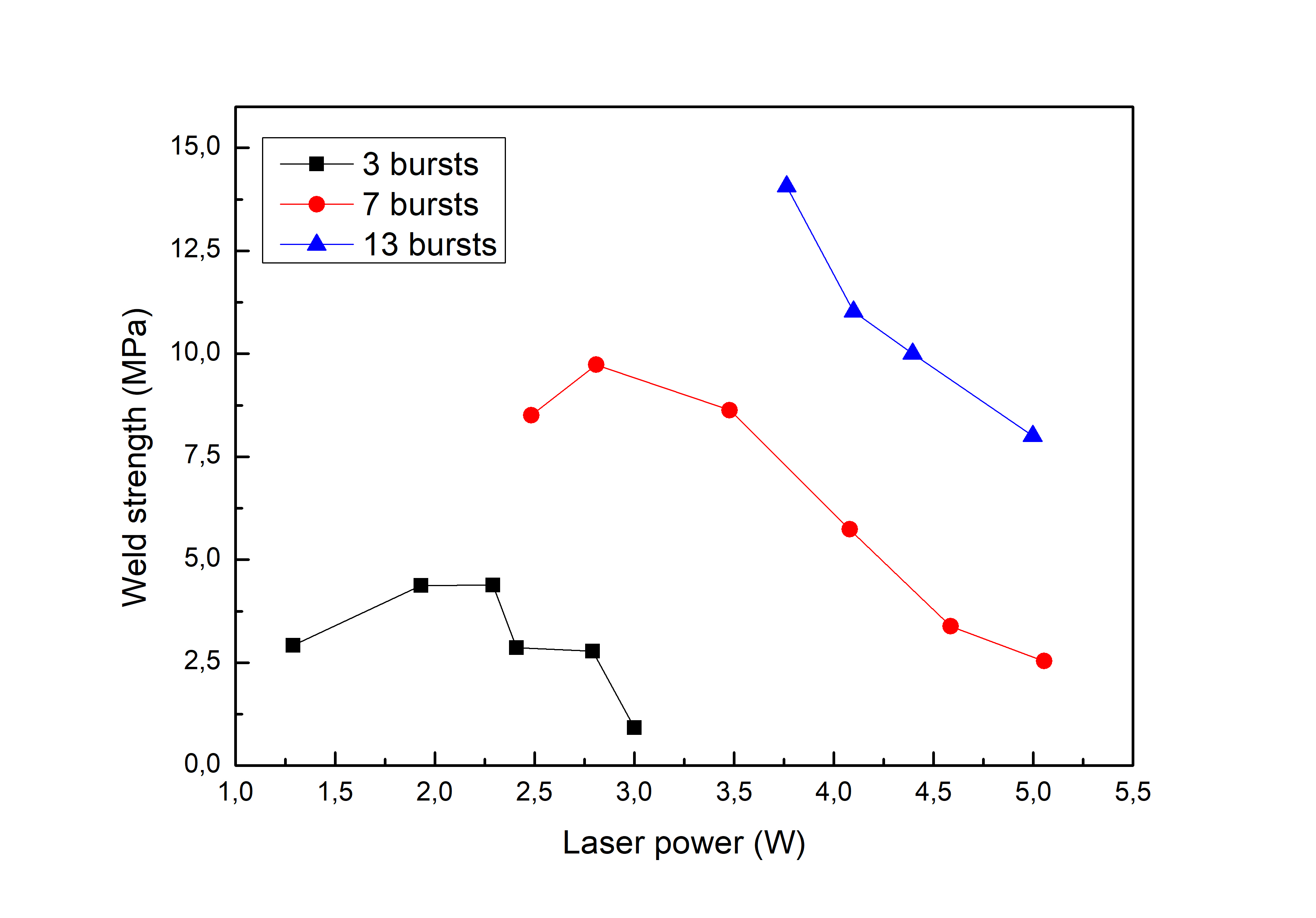
Results indicate (see figure 1) that the average weld strength increased with an increasing number of pulses in a burst. As a result, a maximum strength was achieved for 13 pulses in a burst. Analysis with an optical microscope revealed that the parameter window for a successful weld without cracks narrowed at a higher number of pulses in a burst.