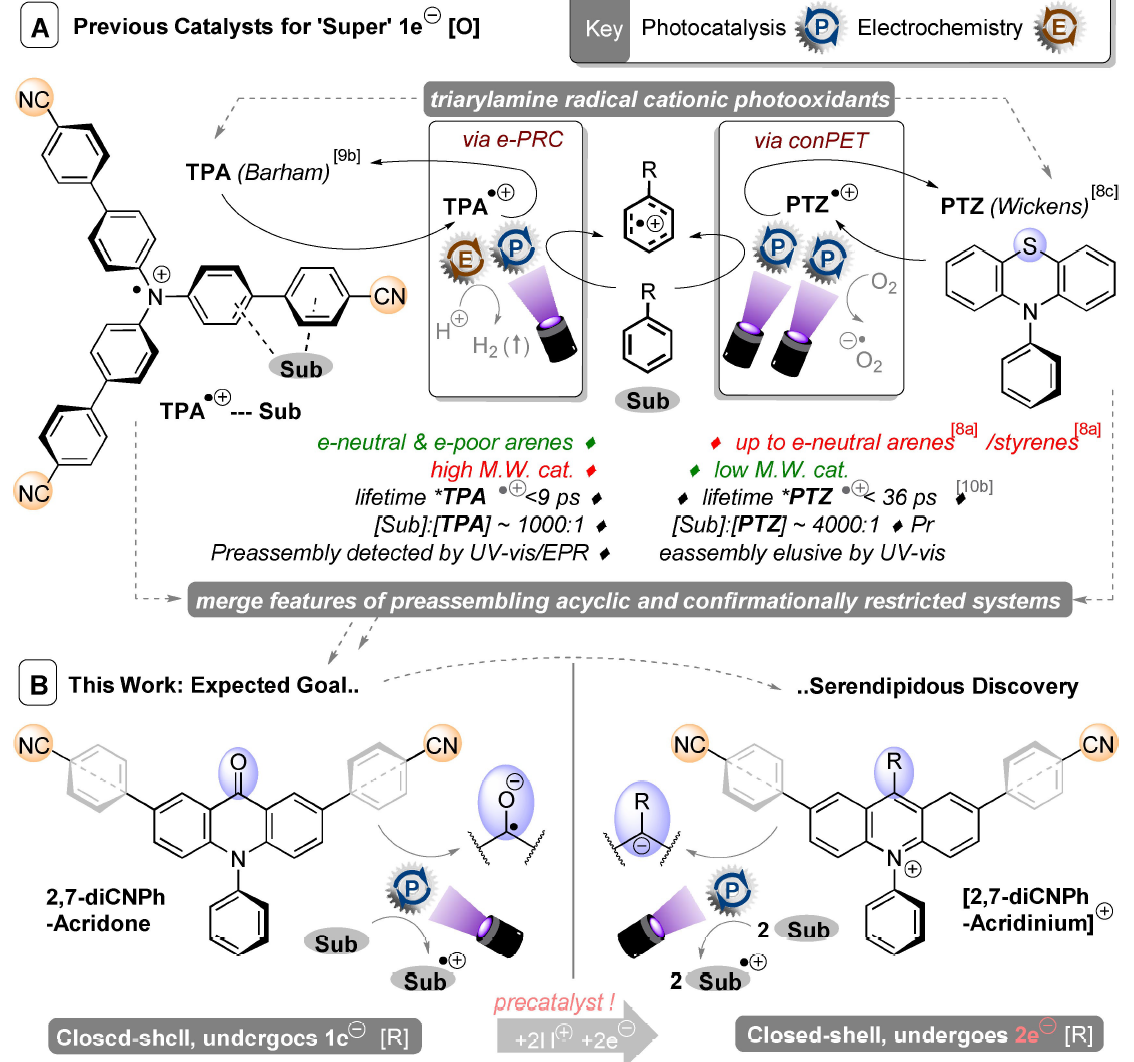
Electron-deficient acridones and in situ generated acridinium salts are reported as potent, closed-shell photooxidants that undergo surprising mechanisms. When bridging acyclic triarylamine catalysts with a carbonyl group (acridones), this completely diverts their behavior away from open-shell, radical cationic, ‘beyond diffusion’ photocatalysis to closed-shell, neutral, diffusion-controlled photocatalysis. Bronsted acid activation of acridones dramatically increases excited state oxidation power (by +0.8 V). Upon reduction of protonated acridones, they transform to electron-deficient acridinium salts as even more potent photooxidants (\(^*\)E1/2= +2.56–3.05 V vs SCE). These oxidize even electron deficient arenes where conventional acridinium salt photooxidants have thusfar been limited to electron-rich arenes. Surprisingly, upon photoexcitation these electron-deficient acridinium salts appear to undergo two electron reductive quenching to form acridinide anions, spectroscopically-detected as their protonated forms. This new behaviour is partly enabled by a catalyst preassembly with the arene, and contrasts to conventional SET reductive quenching of acridinium salts. Critically, this study illustrates how redox active chromophoric molecules initially considered photocatalysts can transform during the reaction to catalytically active species with completely different redox and spectroscopic properties.[1]