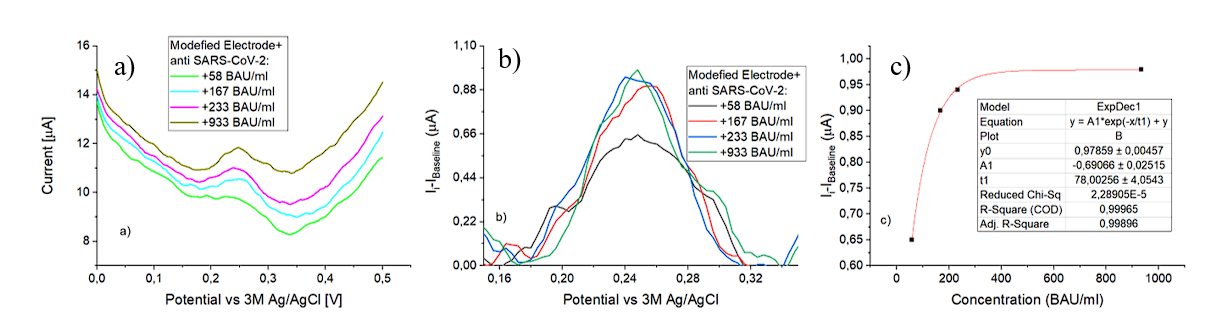
The aim of the research was to prepare, synthesize and characterize electroconductive polymers for sensing of SARS-Cov-2 antibodies. The first step in achieving this goal was to find the best method to synthesize the polymer polyaniline from aniline, which will be the basis for the rest of the sensor. On this basis different surface modifications and protein immobilization methods were explored and the resulting sensing capabilities compared. A proof of concept was built in the form of a Glucose sensor. For that, the protein was absorbed onto the surface via physical adsorption. The absorbed protein was crosslinked with Glutaraldehyde through protein-aldehyde interactions [1]. Two different approaches were tested for the COVID-antibody sensor, the first based on the same mechanism as the glucose sensor, the second utilizes an EDC/NHS linker to directly attach the covid spike protein to the working electrode via a chemical bond [2].
For all electrochemical experiments a three-electrode-set-up was used. The working electrode (WE) was a graphite rod with polyaniline on the tip surface, the counter electrode (CE) was platinum wire that formed a cage like structure around the WE and the reference electrode (RE) was a 3M Ag/AgCl electrode. The polymerization and deposition of Aniline was performed using Cyclic Voltammetry (CV). The sensor abilities were tested with Differential Pulse Voltammetry (DPV) in a redox mediator with increasing concentrations of the analyte.
As Fig. 1 indicates we were able to construct a Highly sensitive covid antibody sensor based on Polyaniline.