
Mechanical vibrations are omnipresent in engineering and development, either as a part of an object’s functionality or as a parasitic effect. Fast and reliable vibration measurement is an indispensable tool for aiding in the design process and providing quality assurance [1]. Especially challenging is the characterization of micro-electromechanical systems (MEMS) and surface acoustic wave (SAW) devices due to small surface displacements in the (sub-)nanometer range and high frequencies in the MHz to GHz range, often in conjunction with a demand for high lateral spatial resolution.
Interferometric optical techniques offer the required sensitivity, but the installed detector usually either limits it to point measurements (single photodiode) or to low frequencies (camera detector). However, as shown on the left-hand side of Fig. 1, by shifting the laser frequency \(\omega_L\) in one of the interferometer arms by \(\Delta\omega = \omega_\text{obj} + \omega_b\), static interference (or sufficiently low beat frequencies \(\omega_b\)) can be obtained even for arbitrarily high vibration frequencies \(\omega_{\text{obj}}\). This is achieved by a pair of acousto-optic modulators (AOMs) with a frequency difference of \(\Delta\omega\) and allows to use camera detectors for vibration frequencies that exceed the frame rate of the camera by several orders of magnitude [2].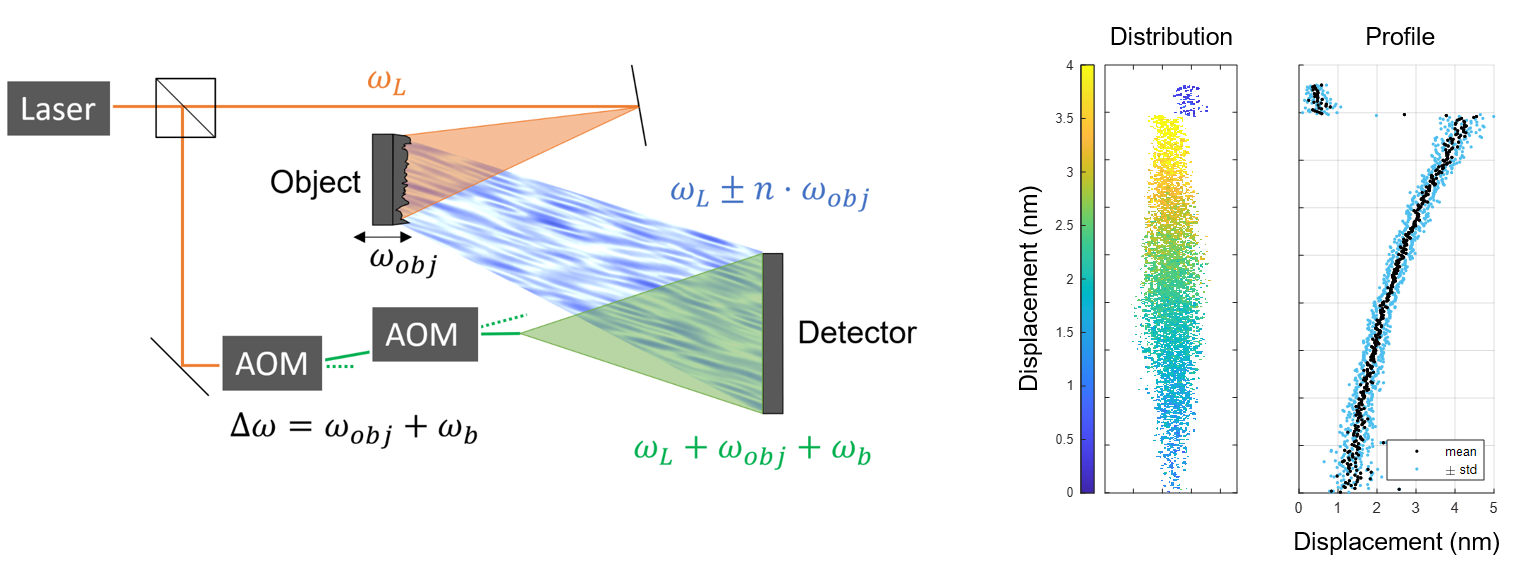
By introducing an additional artificial reference vibration at a frequency close to \(\omega_{\text{obj}}\), a beat between the two acoustic vibrations results. The properties of the object vibration are now encoded in the temporal variation of the observed vibration amplitude. Because the acoustic frequencies are several orders of magnitude smaller than the optical frequencies, the corresponding absolute Doppler frequency shift of the acoustic beat frequency is negligible for virtually all practical situations. This now allows to perform a lock-in detection and accordingly a highly sensitive measurement even in rough environments. The detection limit and noise levels are currently just below 1 nm (Fig. 1, right hand side), but by using longer lock-in time constants, measurements in the pm range or below are expected to become accessible [4].