One category of materials currently under investigation as potential near-infrared emitters are GaAsBi quantum well (QW) structures [1]. With an increase in Bi content, the bandgap of GaAsBi significantly shifts to longer wavelengths and exhibits reduced sensitivity to the temperature, which makes GaAsBi QW structures a promising active medium for tunable optoelectronic devices, which do not require additional cooling [2]. However, the growth of GaAsBi quantum structures requires low growth temperatures, which leads to a high point defect density, resulting in a significant reduction in GaAsBi photoluminescence (PL) intensity.
To optimize the growth of GaAsBi structures it is necessary to investigate optical properties and quantitatively assess emission efficiency of it. Although there are several groups around the world growing GaAsBi structures and investigating optical properties of it, no group has yet attempted to quantitatively evaluate the internal quantum efficiency (IQE) of GaAsBi QW.
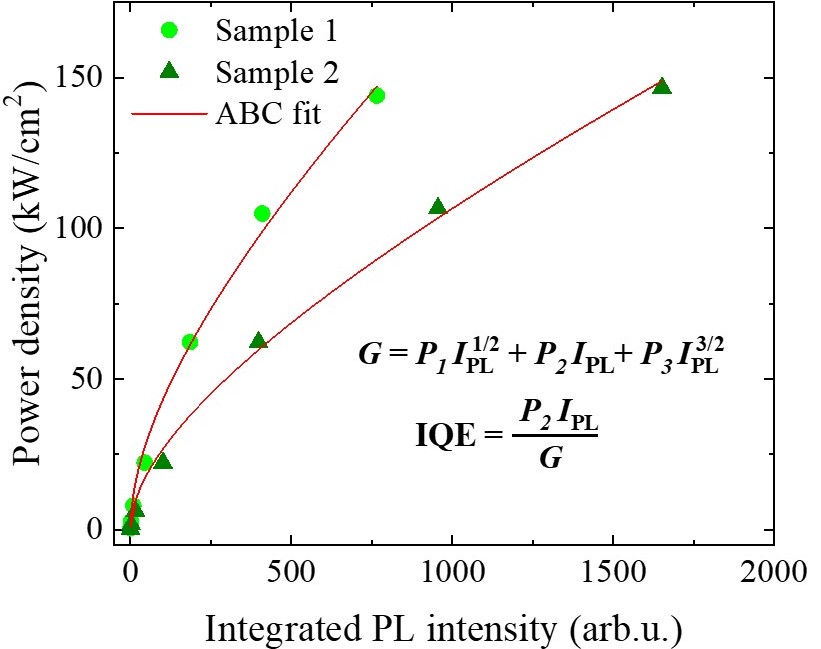
Therefore, in this work, temperature and excitation dependent PL is used to investigate optical properties of GaAsBi structures and quantitatively evaluate the IQE of GaAsBi. Emission efficiency of GaAsBi QWs was investigated using relative excitation-dependent PL measurements and applying ABC method (Fig. 1), which determines IQE as ratio of radiative recombination and total recombination rate [3]. Obtained IQE values were compared with GaAsBi IQE values acquired using other methods. Moreover, a contribution from trap-assisted Auger non-radiative recombination to IQE value was also considered.
Quantitatively assessed emission efficiency allows not only to compare structures grown and characterized in different laboratories, but also to evaluate the amount of non-radiative recombination.