
While historically pervasive across various industries, the extensive use of lead has posed a significant threat to public well-being, particularly through the accumulation of large waste deposits contaminating groundwater. Consequently, this produces a pressing need for precise detection techniques capable of identifying lead ions, even at low concentration levels, and with high specificity. In our work, we explored an electrochemical sensor designed for the selective identification of dissociated lead ions in aqueous solutions, based on the specific interaction with pure MXenes. The sensor was produced using the drop-casting method. The amalgamation of MXenes with Nafion was applied to a graphite electrode surface, repeated three times. The sensor’s performance was assessed using differential pulse voltammetry (DPV), with focus on parameters such as the limit of detection (LOD) and sensitivity. The proposed reaction mechanism involves a reversible conversion between lead ions and lead oxide (PbO) within the MXene layer. The resulting sensor exhibited exceptional selectivity, low LOD values, and the capability to directly detect lead ions in samples without the need for an extensive preparation process. This research establishes a foundation for advancing MXene-based electrochemical sensors, facilitating rapid, portable, and cost-effective testing across a diverse range of applications.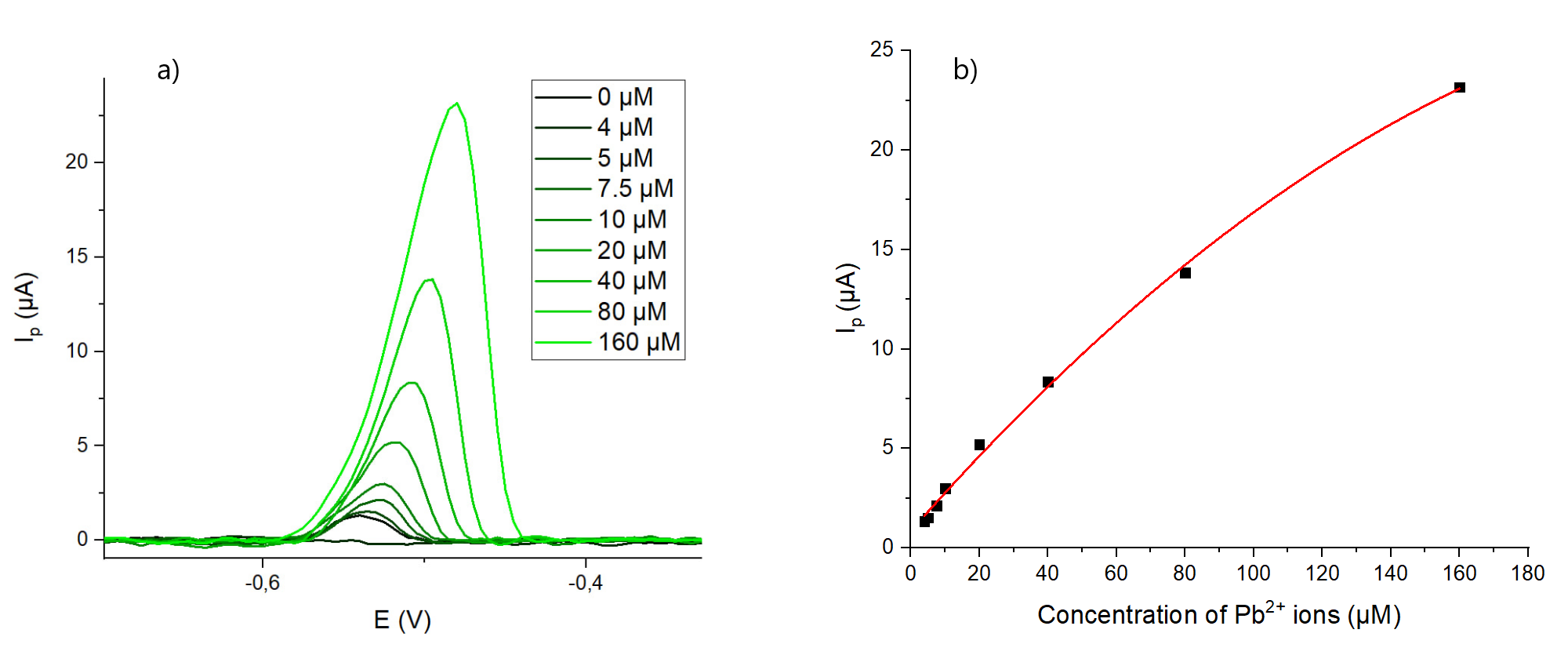
MXENE-BASED ELECTROCHEMICAL SENSOR FOR PRECISE AND SELECTIVE DETECTION OF LEAD IONS IN AQUEOUS SOLUTIONS
Ilya Navitski1, Šarūnas Žukauskas1, Alma Ručinskienė2, Arūnas Ramanavičius1, 3
1 Department of Nanotechnology, State Research Institute Center for Physical Sciences and Technology (FTMC), Sauletekio Av. 3, LT-10257 Vilnius, Lith
2 Department of Electrochemical Material Science, State Research Institute Center for Physical Sciences and Technology (FTMC), Sauletekio Av. 3, LT-10257 Vilnius, Lithuania
3 Department of Physical Chemistry, Institute of Chemistry, Faculty of Chemistry and Geosciences, Vilnius University (VU), Naugarduko g. 24, LT-03225 Lithuania
Fig. 1. Lead ion concentration curves determined by differential pulse voltammetry using a graphite/MXene+Nafion electrode within the range of 4 to 160 µM: a) illustrates the potential drift in response to the presence of lead ions in the sample and measured signal response; b) demonstrates the dependency of the signal on lead concentration