Silicon carbide (SiC) is a wide bandgap material with great potential for high-power and high frequency electronic devices. Furthermore, certain deep-level semiconductor defects have potential applications as qubits and single photon emitters for quantum technologies (QT). SiC hosts a wide variety of defects with QT-compatible properties. In multi-component semiconductors, such as SiC, these defects can often inhabit several configurations with different characteristics. Therefore, a detailed characterization of different defect configurations and their electro-optical properties is essential.
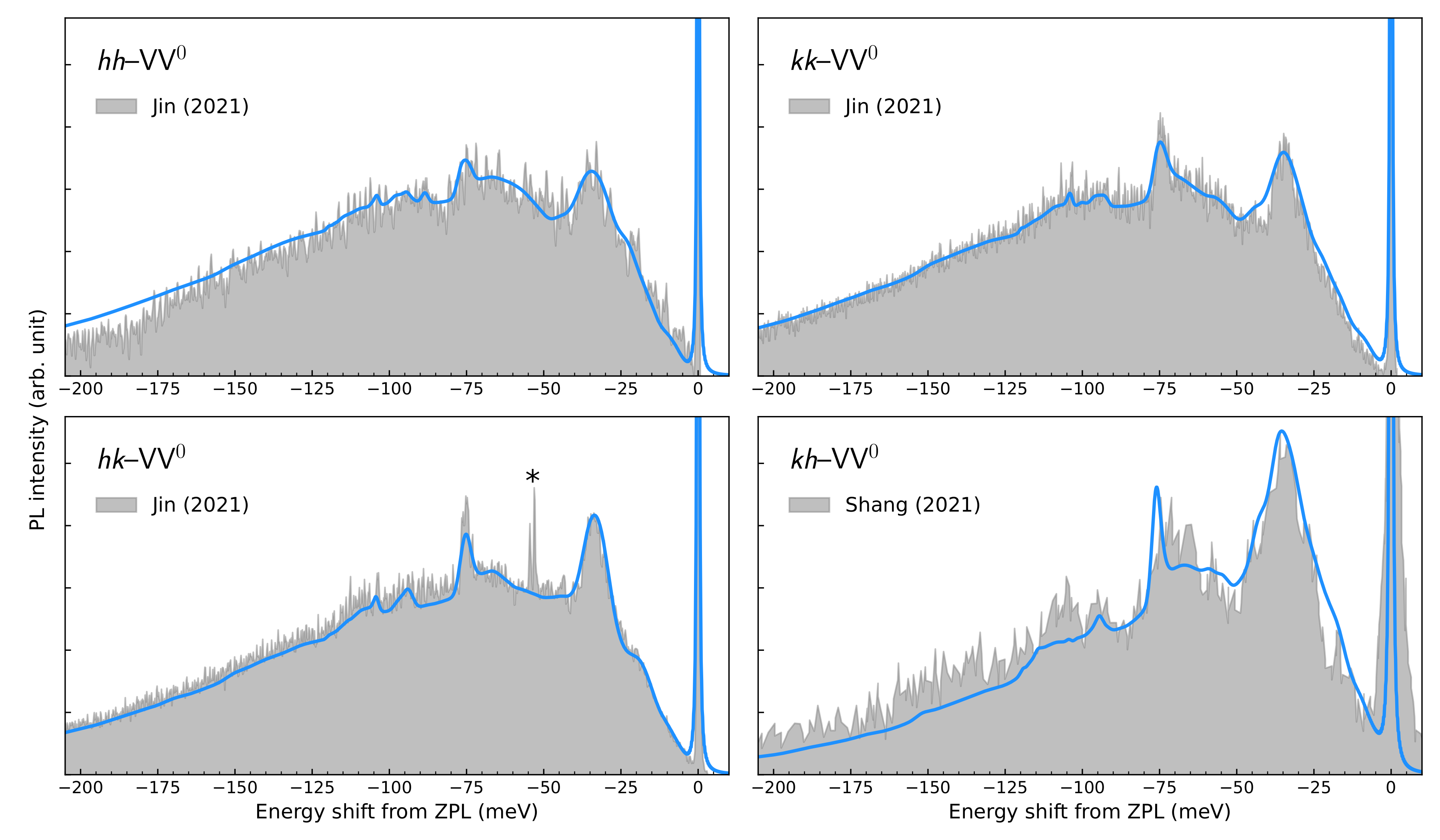
Our study employed first-principles calculations to study four neutral divacancy configurations (hh, kk, hk, and kh) and their vibrational properties in the 4H-SiC polytype. The labels h and k refer to the distinct hexagonal and pseudo-cubic lattice sites in 4H-SiC, respectively. Using the r\(^{2}\)SCAN density functional [1], we have determined the zero-phonon line (ZPL) energies and zero-field splitting (ZFS) values, which are in close agreement with experimental data [2]. Furthermore, we calculated the spectral functions of electron-phonon coupling using a novel embedding methodology [3]. The calculated luminescence lineshapes provide excellent agreement with the experimental data. Additionally, the obtained absorption cross-sections give a comprehensive picture of the contributions of each neutral divacancy defect configuration to the observed photoluminescence spectra.