Andromeda (M31) galaxy is the nearest (785 kpc; [1]) spiral galaxy making it one of the premier laboratories for understanding spiral galaxies like our own. Due to a high inclination (74°–78°) of the M31 disk, it is difficult to determine the galaxy’s large-scale structure. In particular, there is no clear consensus regarding the organization of spiral structure in M31. Therefore, star clusters can be excellent tracers in studies of galaxy formation, assembly and spiral structure, in the sense that significant star cluster numbers are typically produced during major star-forming (SF) episodes in galaxy disks. A substantial portion of the M31 disk was observed by the extensive Panchromatic Andromeda Treasury (PHAT) survey [2] performed with the \(Hubble\) Space Telescope (HST).
The aim of our study is to investigate the spiral structure of M31 galaxy based on the PHAT star clusters. Using aperture photometry data [3-5], we derived cluster parameters: age, mass, extinction, and metallicity. To investigate spiral structure face-on, we deprojected the M31 disk and star clusters assuming the position angle of the galaxy major axis of 37.7° and the inclination of disk of 77.5°.
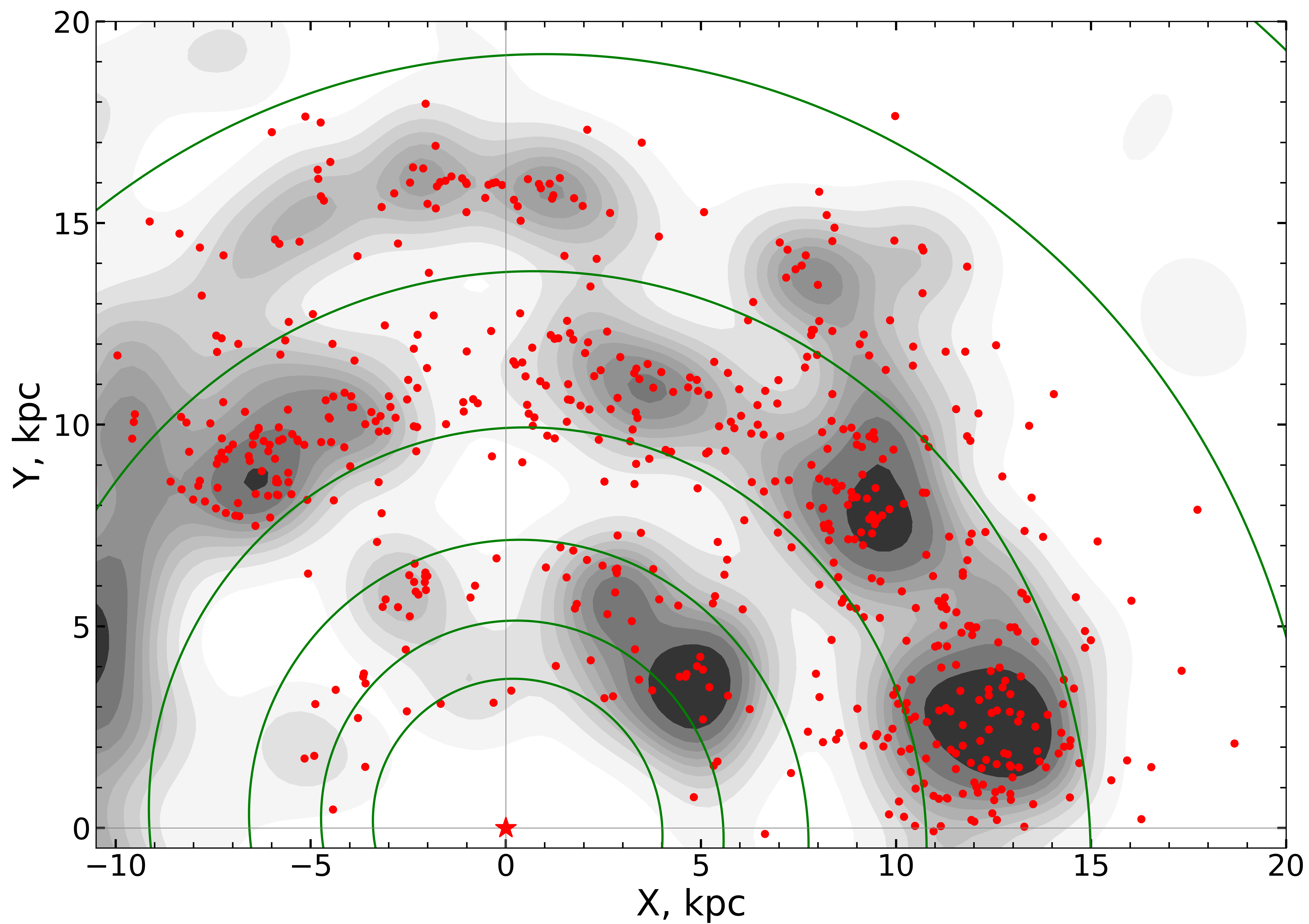
In Fig. 1, we show the distribution of young star clusters (\(<\)50 Myr) with respect to the UV SF regions (grey contours) taken from [6]. Green logarithmic spirals are plotted to roughly follow the spiral structure, with a pitch angle of 3° and phase-shift of -40°. Some young star clusters and UV SF regions deviate from spiral arms, indicating inconsistency with the spiral pattern. Therefore, Fig. 1 clearly highlights the problems addressed in our study.