
Antimicrobial resistance is one of the most important current threats to global health [1]. Stenotrophomonas maltophilia is an emerging opportunistic pathogen responsible for highly lethal nosocomial infections among immunocompromised patients. Its ability to form biofilms as well as high-level intrinsic resistance to a wide range of antibiotics makes treatment of S. maltophilia infections very complicated, requiring alternative antimicrobial strategies [2]. One perspective method is antimicrobial photodynamic therapy (aPDT), which involves a photosensitizer, molecular oxygen and light to produce reactive oxygen species, causing oxidative stress, and killing bacterial cells.
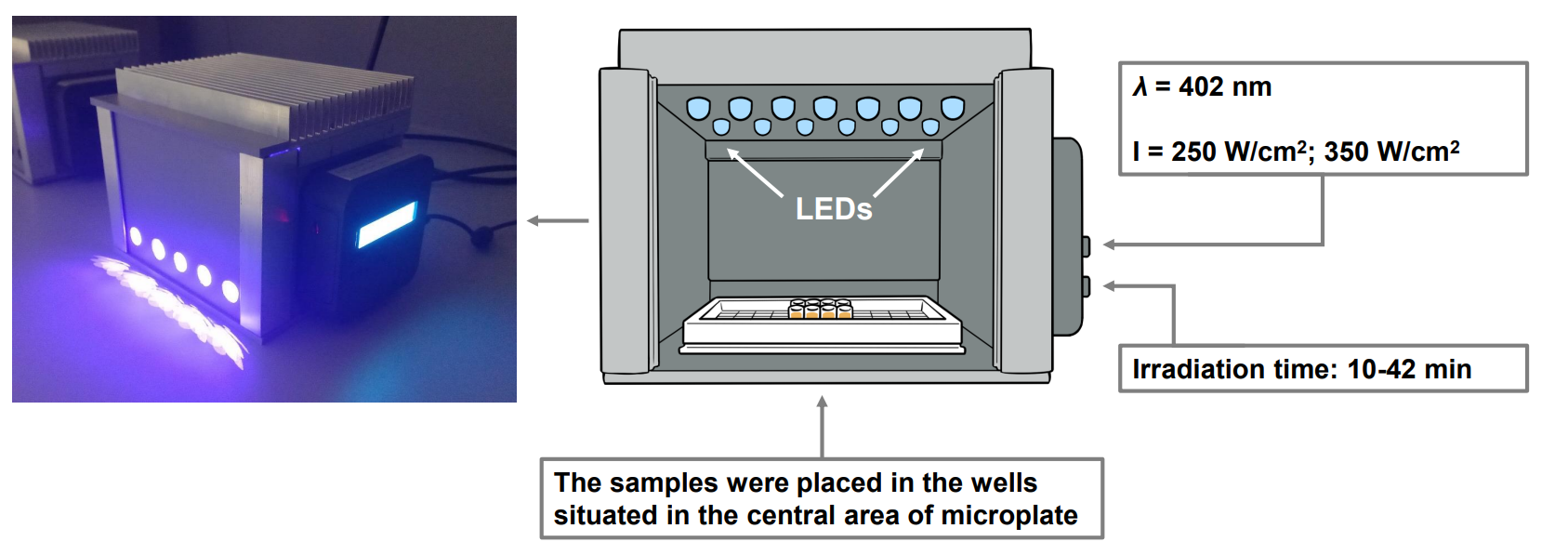
The aim of this study was to analyse the efficacy of chlorophyllin-based aPDT (Chl-aPDT) inactivation against S. maltophilia when exposed to 402 nm light at different irradiances. Chl is a water-soluble chlorophyll derivative also known as a food colorant. Two multidrug-resistant biofilms forming clinical S. maltophilia isolates (SM3 and SM21) were used for Chl-aPDT. Bacterial cultures were suspended with 0.015 mM Chl in the dark. For inactivation, samples were exposed to 250 and 350 W/m\(^2\) irradiance at different periods. The irradiation dose (J/m\(^2\)) was calculated as irradiance (W/m\(^2\)) multiplied by irradiation time (s). Bacterial viability was evaluated by colony-forming unit count (CFU/mL).
The results showed that sensitivity to Chl-aPDT varies among both S. maltophilia isolates. SM3 was inactivated in a similar manner when exposed to the same irradiation dose at different irradiance. In contrast, the viability of SM21 after Chl-aPDT was more than 7-fold lower after irradiation at a dose of 31.5 J/cm\(^2\) with 250 W/m\(^2\) compared to 350 W/m\(^2\), but almost 4-fold higher at a dose of 63 J/cm\(^2\).