Vitrimers are a class of materials that exhibit a dynamic covalent behavior similar to that of traditional polymers, but with the ability to undergo reversible chemical transformations without losing their material properties [1]. This dynamic nature allows to be reshaped, reprocessed, and recycled multiple times without losing their mechanical properties [2]. The ability to undergo reversible reactions makes vitrimers attractive for applications in self-healing, recyclable and shape-memory polymers.
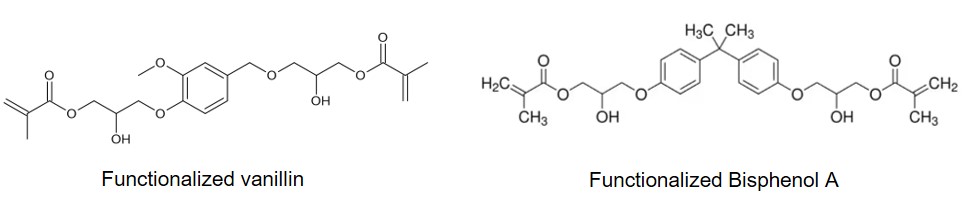
The aim of this research was to synthesize sustainable materials using functionalized vanillin due to its antibacterial and antifungal properties which are relevant nowadays. Functionalized vanillin can be a good alternative to the most widely used cross-linker with the bisphenol A fragment, as it has a vanillin-based backbone with high rigidity and thermal stability. Studies have suggested that bisphenol A can mimic the action of the hormone estrogen in the body. There is ongoing research and debate regarding the potential health effects of bisphenol A exposure, with concerns raised about its possible links to reproductive, developmental, and endocrine-related issues [3]. Consequently, functionalized vanillin (Fig. 1) together with other monomers in different ratios was chosen for the preparation of UV-curable resins. Functionalized bisphenol A was chosen to compare the properties of the resulting polymers. The synthesized vitrimers showed reprocessability, shape memory, and self-healing properties due to a sufficient amount of hydroxyl and ester groups that are beneficial for transesterification reactions. The properties of vanillin-based vitrimers were similar to those of bisphenol A-based vitrimers.