
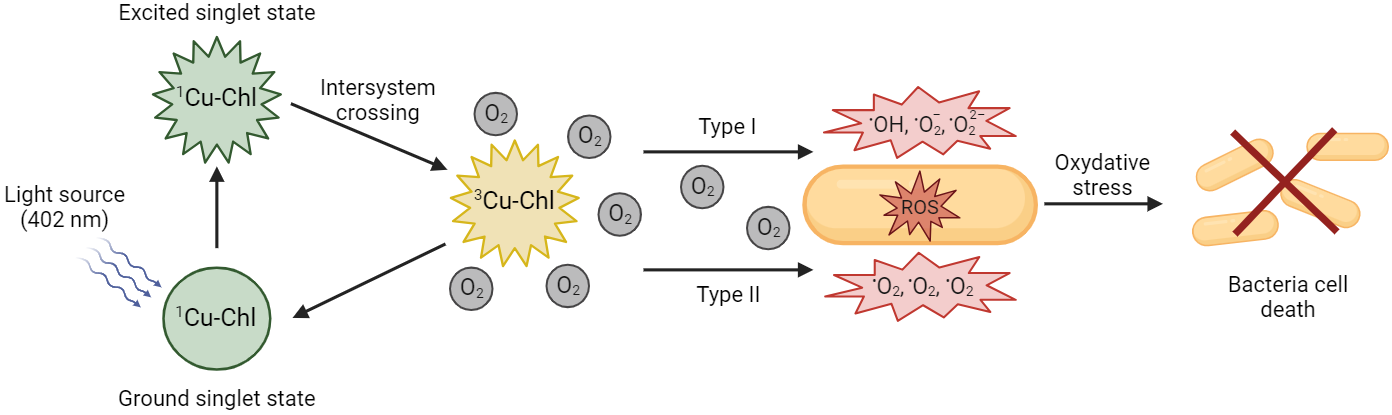
Antimicrobial photodynamic inactivation (API) is a modern biophotonic technology that can fight a wide range of microorganisms. API requires three components: molecular oxygen, a photosensitizer (PS), and light with a wavelength in the absorption region of the PS. The interaction between PS and light in an oxygenated environment leads to photo-oxidative reactions, the formation of reactive oxygen species, and damage to bacterial cells. This versatile mechanism of action makes API a very widely used technique [1].
The antibacterial efficacy of API depends on the photophysical properties of the PS chosen. Desirable properties of PS include water solubility, photostability, minimal aggregation tendency, and a broad spectrum of antimicrobial activity at relatively low PS concentrations and light doses.
Chlorophyllin molecules are macrocyclic organic tetrapyrrole compounds in the class of porphyrins that exhibit large optical nonlinearities, making them a great candidate to be applied as PSs for API. It is known that porphyrins can form aggregates in aqueous media and that aggregation can affect physical properties such as fluorescence emission [2]. One method to determine the formation of aggregates in solution is the use of the aggregate-degrading agent Triton X-100. The main goal of this study is to investigate the physical properties of Cu-Chl by measuring its excitation and emission spectra.
In order to assess the intensity, shape and lifetime of the Cu-Chl fluorescence spectra, measurements of the fluorescence emission and excitation spectra of different concentrations of Cu-Chl in distilled water and phosphate-buffered saline (PBS) were performed. The excitation spectra of both solutions showed a maximum at 402 nm. Therefore, 402 nm was chosen as the excitation maximum for Cu-Chl emission. From the results of the fluorescence emission spectra, the fluorescence of Cu-Chl in PBS buffer is more intense than in distilled water. On the other hand, the addition of the monomeriser Triton X-100 resulted in higher fluorescence.
The prospect of this research involves further investigating the properties of Cu-Chl and antimicrobial effectiveness against plant pathogens.