One of the prospective applications of terahertz (THz) technologies is in the field of telecommunication. Addressing the current challenge of limited capacity in wireless data distribution, particularly within short-range Wi-Fi technology, the introduction proposes the utilization of THz radiation to increase data transfer ratio and enhance the performance of end-user telecommunication systems. The upcoming generation of telecommunication systems (6G), has already allocated THz bands for potential applications such as Tbps WLANs, WPANs, IAB wireless networks, IoT networks, and THz space communication systems [1]. All these applications necessitate signal multiplexing to improve data transfer ratio. In this study, the implementation of multiplexing functionality is realized through the application of a multiple-input multiple-output (MIMO) system, specifically achieving spatial frequency division multiplexing.
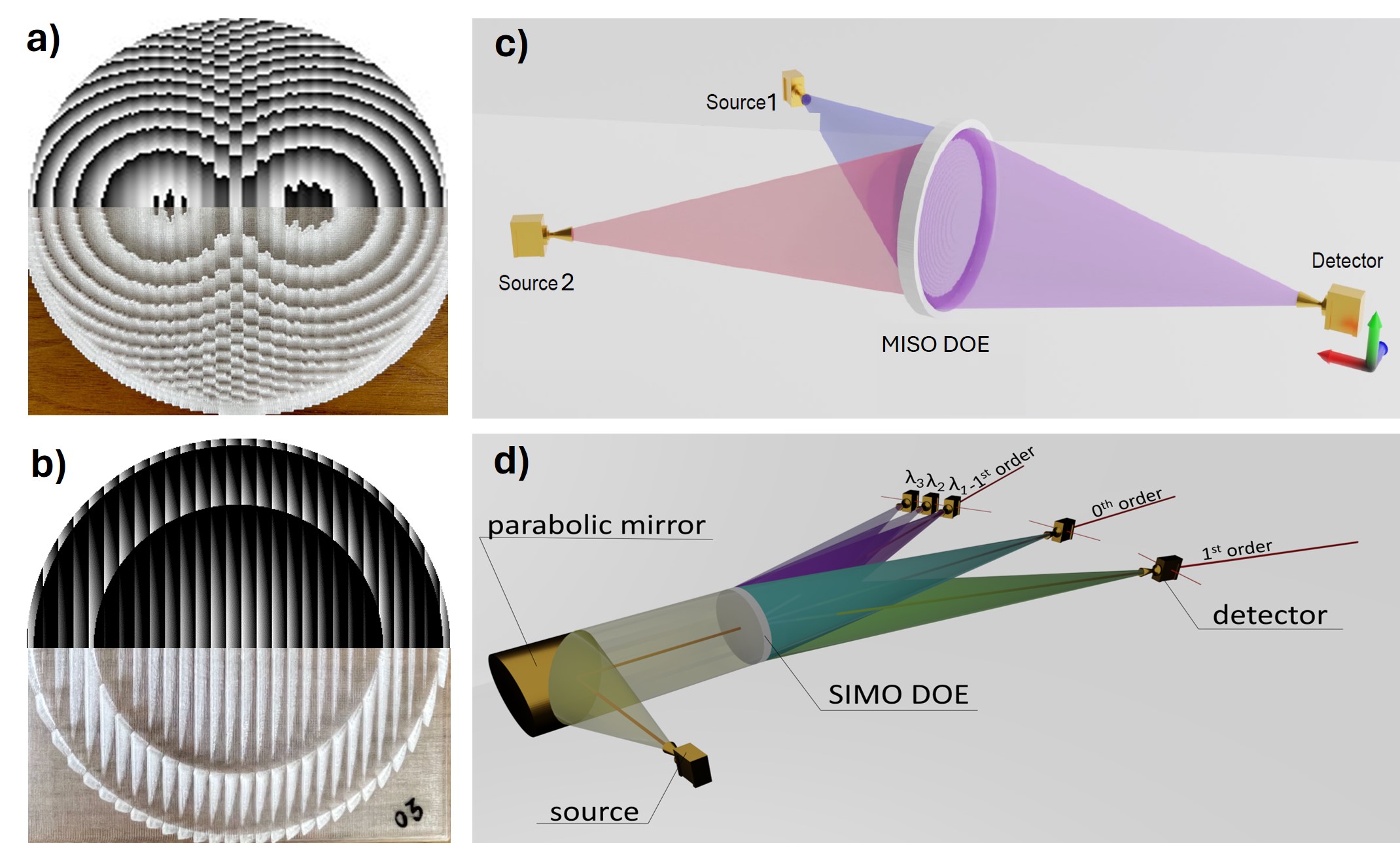
The MIMO system is realized through the incorporation of two diffractive optical elements (DOEs). The first element performs the role of a multiple-input single-output (MISO) system, wherein the DOE combines signals of different frequencies generated by spatially separated radiation sources into a single optical channel. The resultant combined signal beam propagates in free space over a specified distance in the form of a plane wave. Subsequently, the signals are spatially separated by the second DOE, which accomplishes the single-input multiple-output (SIMO) functionality. Consequently, THz signals of varying frequencies can be concurrently gathered by spatially separated detectors.
A crucial aspect of this solution lies in the design of DOEs in the form of kinoform lenses. These appropriately designed structures facilitate arbitrary signal manipulation, resulting in a precisely defined intensity distribution of the output field. The continuous phase profile achieved through kinoform coding ensures a high diffraction efficiency of up to 100% [2]. Fig. 1a and 1b illustrates the phase profiles of the designed MISO and SIMO structures (top image), respectively. The DOEs were manufactured (Fig. 1a and 1b - bottom image) from transparent polymer materials in the THz radiation range using fused deposition modeling (FDM) 3D printing technology. The investigation of optical properties in polymer and composite materials was carried out utilizing THz time-domain spectroscopy (THz TDS) [3], enabling the selection of cyclic olefin copolymer (COC) and styrene-butadiene copolymer (SBC) materials for this specific application. The schematic representation of the functionality of each structure within the THz optical system is depicted in Fig. 1c and 1d.