Due to the rapidly developing epidemiological situation of cancers, the scientific world is focusing on developing more innovative cancer research methods. Combining knowledge and skills in biomedicine and engineering is key to achieving this development. Therefore, research focusing on providing new instruments, fabricated in the form of microfluidic lab-on-chips (LOC) utilizing additive manufacturing (AM) supported by hydrogel matrix (HM) was provided towards innovative cancer cell studies, especially with a view to photodynamic therapy (PDT).
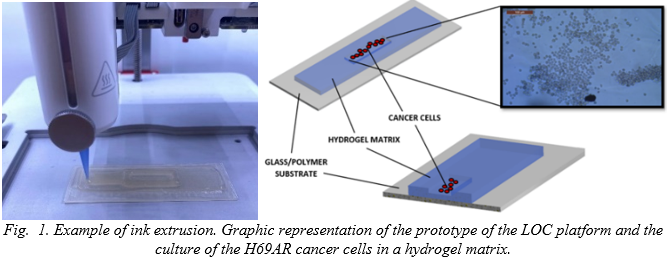
In this work, 3D printing of a biocompatible HM (technology: extrusion) on glass and polymer substrates was used to fabricate a LOC platform (Fig. 1). The polymer substrates were additively manufactured using photo-resins, such as VisiJet M3 Crystal (technology: MultiJet) and KeyGuide (technology: Digital Light Processing). Next, the key structural part of the platforms – HM – was prepared utilizing the following compostions of natural polymer powders such as sodium alginate, gelatin, chitosan, agar, and methylcellulose. Thus, various biocompatible inks could be obtained.
The AM process of hydrogels is presented in Fig. 1. The cross-linking process of the biopolymers was conducted using a calcium chloride solution (0.1M). The AM procedure involved e.g. the printing pattern, syringe speed, ink temperature, dosing speed, extrusion pressure, and nozzle diameter. The goal of AM of the HM was to include microchannels and microchambers in the matrix to provide spatial cell culture and transport of nutrients and oxygen. Nevertheless, the following difficulties were encountered during this process, e.g.: lack of repeatability, clogging of the printing nozzle, and geometry instability. However, most of these problems were solved; ultimately, the deposited layers had defined geometries, allowing for the implantation of cancer cells.
As part of the 3D printing experiments, the geometrical reproduction of the designed 3D model was evaluated. Additionally, the control ink was a commercial ink dedicated to the BIO X 3D printer used. The H69AR lung cancer cells, highly resistant to therapeutics, were used for in vitro studies. The culture was carried out to check the cytotoxicity of the LOC materials. For this purpose, cell viability and proliferation assays ensuring qualitative (Trypan Blue staining) and quantitative (Presto Blue reagent) evaluation were done. The reference was the control sample (cells in culture medium), in which viability was assumed to be 100%.
The primary research showed the high applicability of the device, however further investigation has to be done. The next step will be the optimization of the LOC platform – AM of LOC with microchannels, e.g., for cell perfusion. Furthermore, the research will focus on developing and applying anticancer PDT directly on the chip.