1 Department of Polymer Chemistry and Technology, Kaunas University of Technology, Radvilenu Plentas 19, LT50254 Kaunas, Lithuania
2 Department of Materials Science and Engineering, National Tsing Hua University, No. 101, Section 2, Guangfu Rd., East District, Hsinchu, Taiwan, 30013
Organic light-emitting diodes (OLEDs) transcend the capabilities of conventional diodes, excelling in performance, durability, and manufacturing processes [1]. Notably, OLEDs offer self-illumination, wide viewing angles, rapid response times, high color contrast, low operating temperatures, exceptional color rendering index (CRI), soft and diffused emission, full-spectrum color reproduction, color tunability, planar design, spectrum tailoring, unbreakable construction, lightweight and thin form factor, flexibility, transparency, ease of molecular design, utilization of sustainable materials, energy-saving characteristics, human and eco-friendliness, and low driving voltages [2]. Organic electroactive materials are extensively synthesized and studied as components of the mentioned devices. Bipolar organic derivatives can be used as materials of emitting layer of OLEDs.
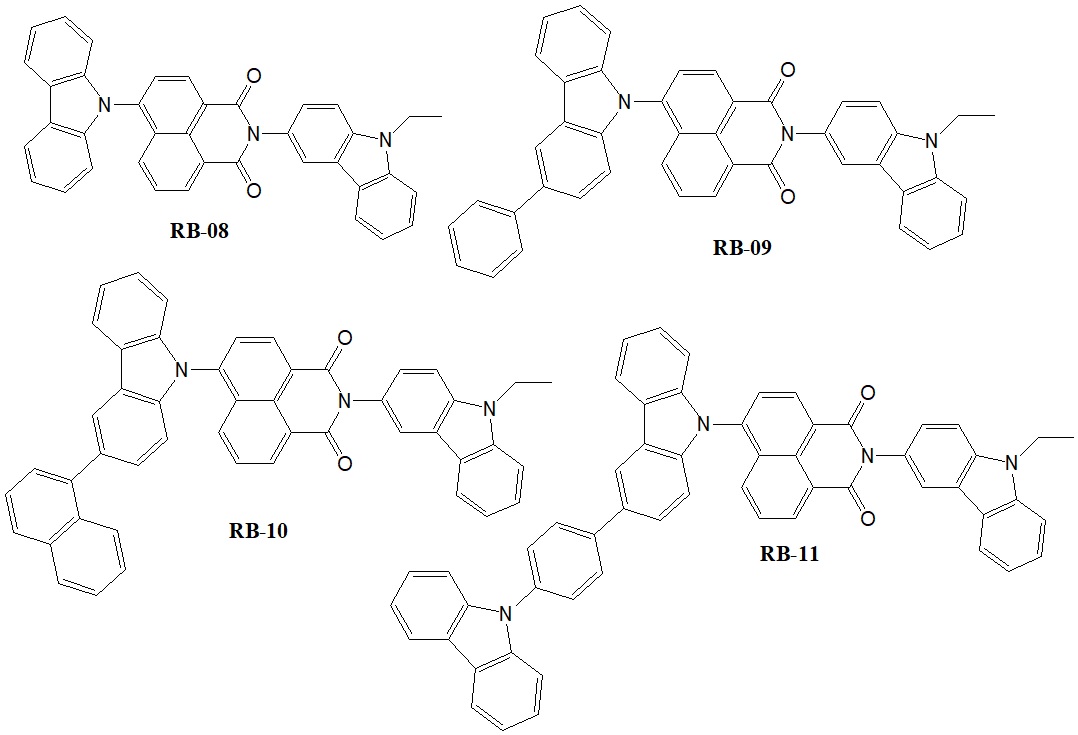
In this study, we present new potential emitters containing naphtalimide core as electron acceptor and carbazole or arylcarbazole fragments as electron donors. Some of the new materials demonstrated promising electroluminescent characteristics as emitters in the OLED devices. The structures of compounds are shown in Figure 1.
Fig. 1. Structures of compounds
These compounds exhibit desirable characteristics such as a wide bandgap, high decomposition temperatures (306-366 oC) and very high glass transition temperatures (133-179 oC). The experimental results showed that one incorporating 5 wt% RB-11 emitter demonstrated superior performance, achieving maximum power efficacy of 7.7 lm/W, maximum current efficacy of 7.9 cd/A and maximum external quantum efficiency of 3.3%. The CIE coordinates of (0.29, 0.52) of RB emitter based device indicated an efficient and stable green OLED with peak emission at 520 nm. Finally, the synthesized naphtalimide-based compounds show promising potential as efficient green emitters for OLED applications. These cost-effective materials exhibit suitable photophysical, electrochemical, and thermal properties, making them suitable for a range of display and solid-state lighting applications.
[1] Jou, J.-H. Introduction to OLED; Gau Lih Book 10, Ltd.: Taiwan, 2015; ISBN 978-986-378-031-1.
[2] Jou, J.-H.; Singh, M.; Su, Y.T.; Liu, S.H.; He, Z.K. Blue-Hazard-Free Candlelight OLED. J Vis Exp 2017