Channels formed in glass have a variety of applications [1], for example in microelectrochemical systems, for the creation of nozzles, and others. Laser milling allows for the formation of small diameter and high-aspect-ratio channels [1]. Additionally, by focusing the laser beam to the bottom of the sample surface, parallel side walls are produced. Furthermore, scattering is reduced because debris does not go in the beam path, increasing the milled rate and depth [2]. Debris is often the limiting factor for the creation of high-aspect-ratio channels [3]. Therefore, additional debris removal methods need to be employed.
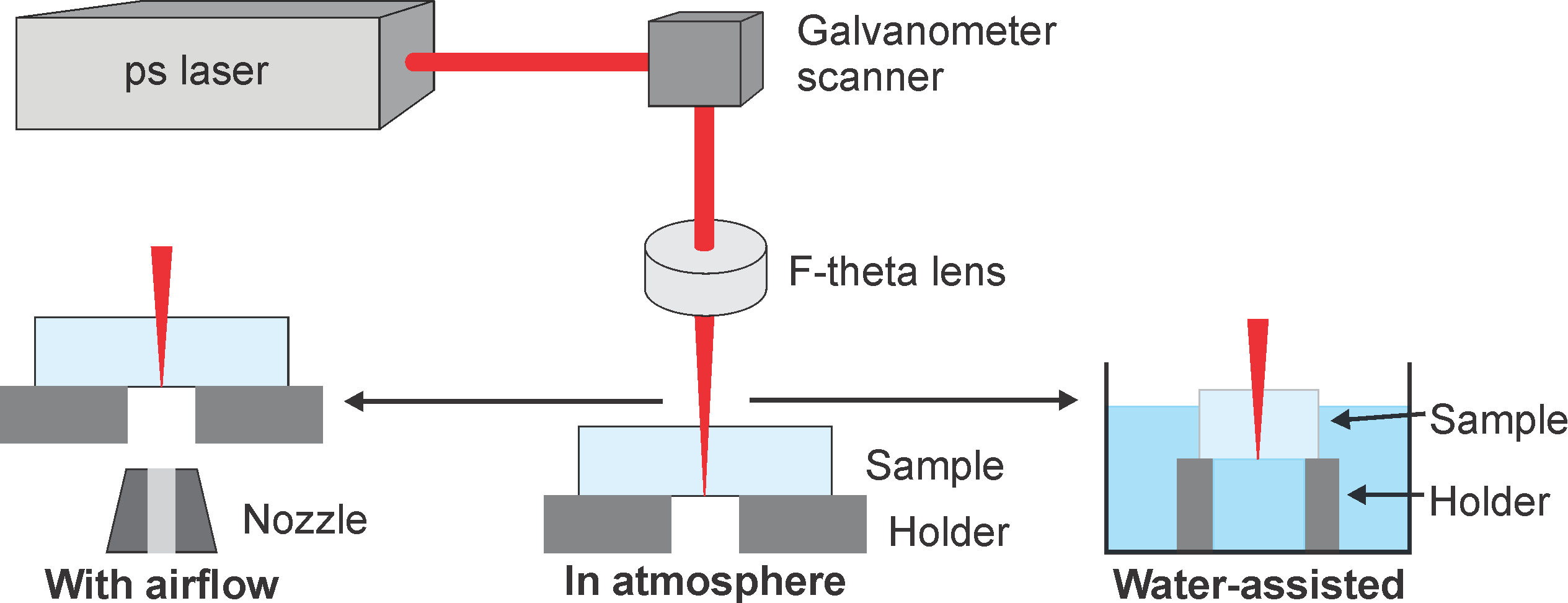
In this study, both continuous and pulsed airflow, no additional debris removal, and partial immersion of the sample in still distilled water (referred to as water-assisted) were employed, as illustrated in Fig. 1. Compressed airflow was blown at the laser interaction zone from a nozzle placed under the sample. Milling was done with a 1064 nm wavelength laser with a pulse duration of 13 ps (full-width-half-maxima) and the bottom-up technique. Firstly, the milling parameters were optimized to achieve the highest milling rate. After that, channels were milled through the entire 6.3 mm of fused silica, using various debris removal methods to find the smallest diameter. Lastly, tilted channels were formed by introducing an offset after each scanning loop to achieve the highest angle.
The smallest diameter was achieved when channels were formed using continuous airflow in 6.3 mm thickness fused silica which was further reduced when milling smaller 1 mm depth channels. However, water-assisted milling allowed the formation of a channel with a higher angle.