FULL-FIELD OPTICAL COHERENCE TOMOGRAPHY WITH DIGITAL DEFOCUS CORRECTION
Austėja Trečiokaitė1, 2, Karolis Adomavičius1, Egidijus Auksorius1
1 State research institute Center for Physical Sciences and Technology
2 Vilnius University
Full-Field Optical Coherence Tomography (FF-OCT) is a fast, non-invasive/non-destructive interferometric technique for acquiring high-resolution en face images at large depths within the sample. In order to avoid as much of the interference noise as possible, a low-coherence light source is used, instead of a laser that is commonly used in holography/interferometry. However, computational aberration/defocus correction, which is possible in Fourier-domain FF-OCT systems using lasers [1][2], is challenging when using incoherent light source, such as LED.
Here we demonstrate a digital defocus correction over a large range of defocus values in FF-OCT employing LEDs. To this end, we show defocus correction on various - reflective and scattering samples.
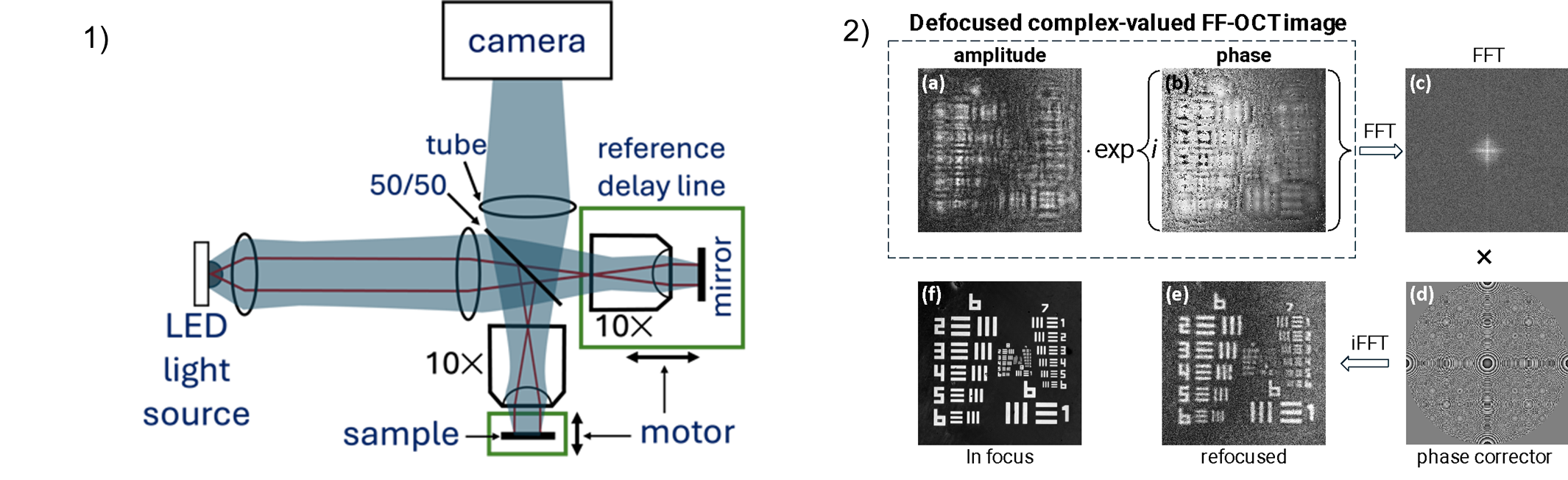
Fig. 1. 1) Principal scheme of FF-OCT system. Dark blue represents spatially incoherent LED illumination path, red – spatially coherent laser. Green boxes indicate translation stages equipped with stepping motors. ) Digital defocus correction of complex-valued TD-FF-OCT image of USAF target defocused by 1 mm (u = 676.4). The complex-valued signal, consisting of amplitude (a) and phase (b), is Fourier-transformed (c), then multiplied by a quadratic phase function (d), and subsequently inverse Fourier-transformed, resulting in a refocused image (e). An in-focus image is provided in (f) for comparison.
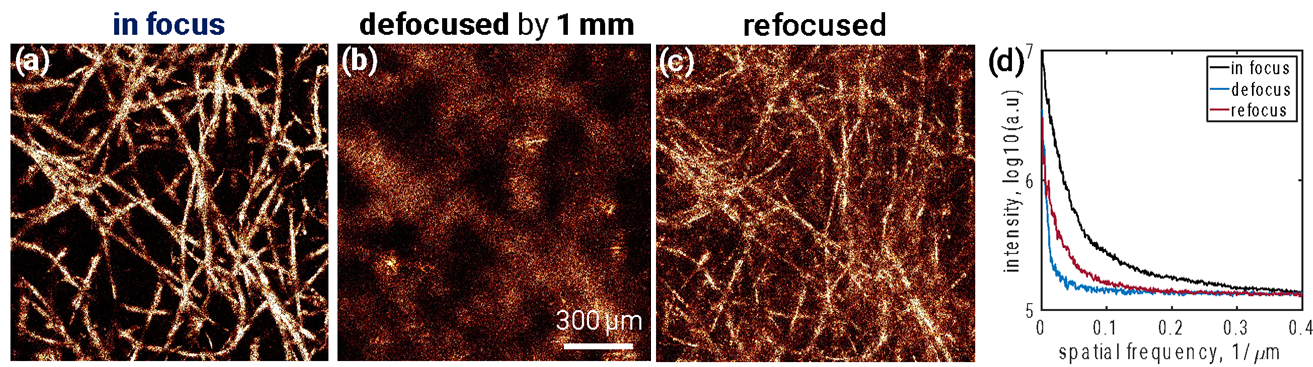
Fig. 2. Digital defocus correction of TD-FF-OCT images acquired 100 µm beneath lens tissue surface. (a) in-focus TD-FF-OCT image, (b) TD-FF-OCT image physically defocused by 500 µm. (c) digitally refocused TD-FF-OCT image. (d) spatial frequency spectra for three images displayed in (a), (b) and (c). The images are normalized whereas curves in (d) are produced from original (non-normalized) TD-FF-OCT images.
Overall, digital defocus correction of images created with TD-FF-OCT systems can be implemented over a much larger range than the Depth of Field (DOF). As DOF with used optics is 10 µm, defocus values up to 1 mm can be negated although with certain spatial resolution and intensity losses. Alongside the use of incoherent light sources, TD-FF-OCT holds an advantage over other holographic microscopy techniques due to reduction in the number of coherent artifacts granting an increase in imaging depth.
[1] A. Dubois et al., “Ultrahigh-resolution full-field optical coherence tomography,” Applied Optics, vol. 43, no. 14, p. 2874, May 2004. doi:10.1364/ao.43.002874
[2] A. Kumar, W. Drexler, and R. A. Leitgeb, “Subaperture correlation based digital adaptive optics for full field optical coherence tomography,” Optics Express, vol. 21, no. 9, p. 10850, Apr. 2013. doi:10.1364/oe.21.010850