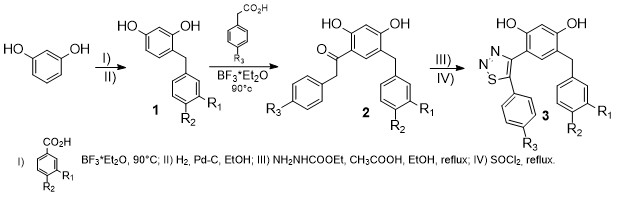
Inhibitors of the Hsp90 chaperone protein hold significant potential in the quest for anticancer drugs. Hsp90 client proteins play a crucial role in regulating various functions of human cells, including signal transduction, protein trafficking and cell proliferation. However, these proteins are prone to mutation and are overexpressed in cancer cells. Therefore, inhibiting them holds substantial promise for combating cancer [1]. Results from clinical and preclinical studies indicate that Hsp90 inhibitors may enhance the effectiveness of other cancer treatments, such as chemotherapy or immunotherapy [2]. 4,5-diaryl-1,2,3-thiadiazoles are promising anticancer agents, and many similar compounds have yet to be thoroughly investigated [3].This research aims to synthesize 6-(5-aryl-1,2,3-thiadiazol-4-yl)-(4-benzyl)benzene-1,3-diols 3 as potencial Hsp90 inhibitors.
The synthesis is carried out in five steps to obtain the target compounds. The first and third steps of the synthesis are the same and involve Friedel-Crafts acylation. After the first reaction, the obtained ketones are reduced with Pd-C, in H\(_{2}\) gas atmosphere and gives 4-(benzyl)benzen-1,3-diols 1. The final stage of the synthesis is the Hurd-Mori cyclization reaction. Ethyl carbazate is attached to the successfully isolated compounds 2, the five-membered ring is cyclized with thionyl chloride and final products 3 are obtained.