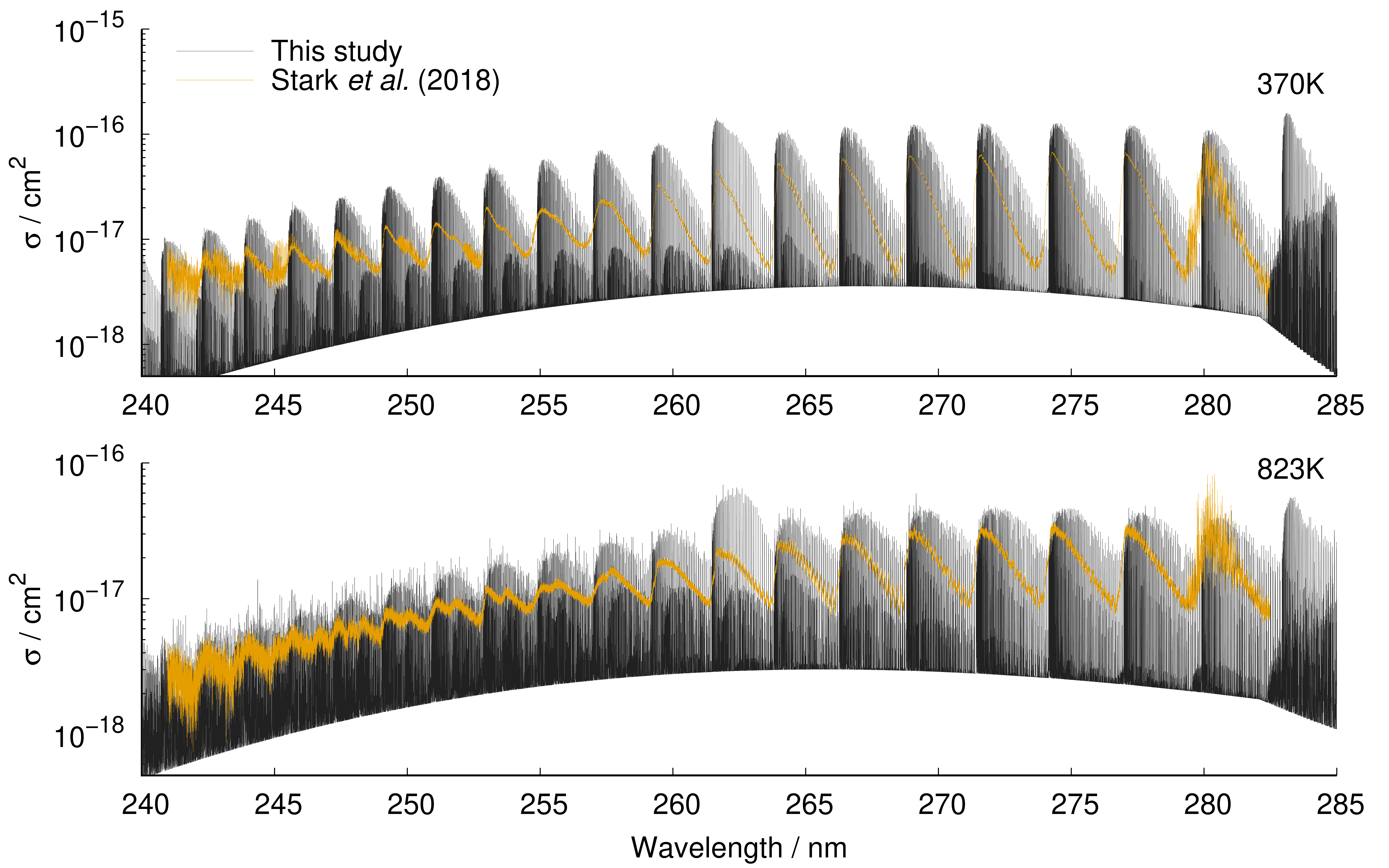
Availability of accurate and high-resolution spectra for atmospheric and interstellar photochemistry modelling is a necessity when considering isotopic fractionation and shielding effects. There still are numerous diatomic compounds with missing UV absorption cross-sections that are very complicated to measure in laboratory setting. To provide some insight into sulfur photochemistry in Archean atmosphere, two key diatomic molecules should be highlighted: S\(_2\) [1] and SO [2].
The ab initio potential energy curves were calculated for both compounds using Molpro2015 package at MRCI-F12+Q/aV(5+d)Z level of theory. The total absorption cross-sections for SO were calculated for A\(^3\Pi\) \(\leftarrow\) X\(^3\Sigma^-\) transition, and two nonadiabatically-coupled-potential ([C\(^3\Pi\) - C\(^{\prime 3}\Pi\)] \(\leftarrow\) X\(^3\Sigma^-\), and [B\(^3\Sigma^-\) - 3\(^3\Sigma^-\)] \(\leftarrow\) X\(^3\Sigma^-\)) transitions. For S\(_2\) molecule, the photoabsorption spectra were calculated for the transitions between ground state, X\(^3\Sigma_{g}^{-}\), and two excited states: B\(^{\prime\prime3}\Pi_{u}\) and B\(^3\Sigma_{u}^{-}\). The spectra were calculated using time-independent R-matrix theory for one-dimensional systems. With this approach we can obtain the numerical solutions for the energies and wavefunctions of all discrete vibrational states on all electronic potential energy curves. If required, we can also include the nonadiabatic coupling between electronic states.
As shown, the theory enables the calculation of highly accurate absorption cross-sections that can substitute, or extend, experimental spectra where the experiments are not feasible. Such spectra also provides a way towards studies of isotopic fractionation, self-shielding and photochemical modelling.