
Micro-structuring of materials is one of the most widely applied fields in science and industry. The main objective of surface structuring is to tailor the properties of the outer layer of a material to meet specific functional, aesthetic, or performance requirements [1]. The complex interplay between laser characteristics and dielectric materials provides insight into how specific laser parameters shape the structural and functional properties of these materials. The diffraction limited focus point size is directly proportional to the wavelength, so a smaller spot size leads to the precision. Thanks to the short UV wavelength, it is possible to ablate materials with high precision and obtain a smooth surface morphology [2]. When the pulse is short, the laser energy is very intense on the target, resulting in a cleaner, more precise ablation process and ability for highly accurate control of the depth of the infringement [3].
The precision and smoothness is a must for the fabrication of DOE-phase micro structured elements. One of the most commonly used diffractive elements is the Fresnel zone plate, but due to the limited resolution and the size of the possible structure, researchers have developed a new diffractive element, the photon sieve [4]. It consists of a series of pinholes of different depths spread over the entire Fresnel zone plate. Photon sieves can be used to obtain a sharper focus, which is not dependent on the width of the zone area buton the dimensions of the pinholes [5].
This article describes the influence of laser parameters on the micro-structuring of fused quartz by single pulses of
"PHAROS
" femtosecond laser radiation. The results are analyzed, the dependences of depth, width and volume on the pulse energy are investigated and the most suitable parameters for fabricating photon sieves are selected. Five photon sieves of different periods (\(T= 4, 5, 6, 8\) and \(10 \mu m\) ) have been created with a focal length of \(9\) \(mm\).
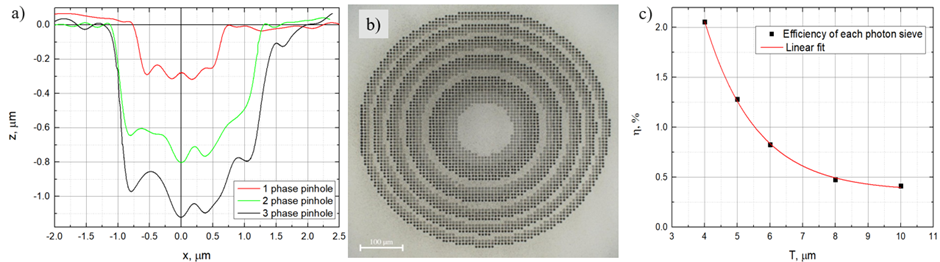
The highest efficiency obtained was for a \(T= 4\mu m\) period photon sieve, which was \(2.06 \%\). Compared to the studies using the same elemental design method, the efficiency value is \(1.75\) times higher (\(\eta = 1,18\%\) [5]). Also, this effiency is achieved with a focal length of \(9\) \(mm\), that is \(17\) times smaller (\(f = 150 mm\) [5]).