
Efficient methods for generating high-energy picosecond pulses with high beam quality are still a challenge, as conventional picosecond pulse generation methods have certain limitations. Q-switching prevents pulses shorter than \(\sim\)0,3 ns [1], while mode locking limits the pulse energy, to the order of \(\mu\)J [2]. We have recently demonstrated energy-scalable an efficient self-seeded single-cell SBS configuration [3] to achieve the ultimate >10 times pulse compression of \(\sim\)1.1 ns pulses from a commercially available Nd:YAG mini-laser. The shortest pulse width of \(\sim\)93 ps at the output of the double-pass SBS-PCM Nd:YAG amplifier with an improved beam quality and reduced beam pointing fluctuations by a factor of 4 compared to a conventional MOPA was achieved [3]. The goal of this study was to further investigate and upgrade it to a four-pass self-seeded dual-cell SBS-PCM configuration (Fig. 1). Particular attention was also paid to ensuring a high-quality output beam, as well as the long and short-term stability of the laser.
In our experiment Nd:YAG passively Q-switched mini-laser operating at a repetition rate of 10 Hz was used as the source of initial pulses with a duration of 1.05 ns and an energy of \(\sim\)2 mJ at a wavelength of 1064 nm. After four-pass Nd:YAG amplifier without SBS-PCM, \(\sim\)20 mJ of pulse energy was achieved with a signal pulse energy of 270 \(\mu\)J. However, taking into account the equations of Frantz-Novick maximum energy of \(\sim\)45 mJ can be achieved with a maximum seed energy of 2 mJ.
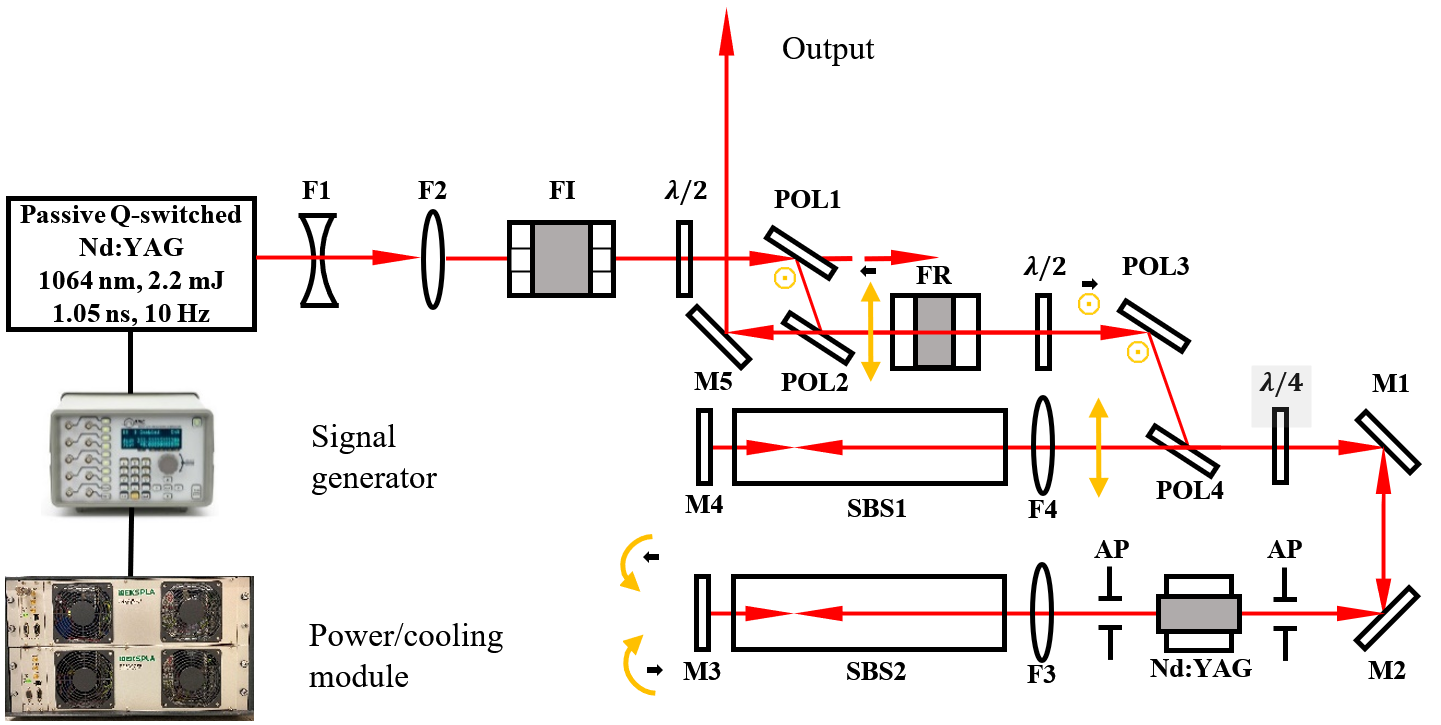
Also, two SBS cells were implemented into this four-pass amplifier configuration to compress the pulse width and improve the beam quality. This self-seeded four-pass SBS-PCM amplifier layout lets us expand the laser beam diameter up to \(\sim\)4 mm to avoid optical damage threshold and achieve up to \(\sim\)40 mJ output pulse energy with Sub-90 ps pulse width.
To conclude high output pulse energy laser based on SBS-PCM in sub-90 ps scale with good beam quality was developed. It can be applied in dermatology as tattoo removal, as it has a good beam quality that prevents scar formation. Finally, this laser system also a good candidate for high-throughput interference patterning of a metal surface to impart water-repellent properties.