
\(NH\){3}\(PbCl\){3}$ HYBRID PEROVSKITE} Recently, hybrid organic-inorganic compounds have attracted immense attention of the scientific community due to their diverse physical and chemical properties. One of the most interesting and researched subgroups of hybrid perovskites is methylammonium (MA) lead halides MAPbX\(_3\) (where X = I, Br, Cl), due to their potential applications in efficient and low-cost solar cells, LEDs, and photodetectors [1].%.
Here, we use electron paramagnetic resonance (EPR) spectroscopy to study the dynamics of methylammonium cations and structural phase transitions in methylammonium lead chloride CH\(_3\)NH\(_3\)PbCl\(_3\) . In this work, we employ temperature dependent multifrequency continious-wave (CW) and pulsed EPR spectroscopy to characterize paramagnetic Mn\(^{2+}\) probe ions in MAPbX\(_3\). The temperature dependent CW spectra reveal a sudden increase in the zero-field splitting of the Mn\(^{2+}\) ions at about 175~K (Fig. 1). This indicates a first-order phase transition related to the deformation of the inorganic framework due to the tetragonal-orthorhombic symmetry lowering. 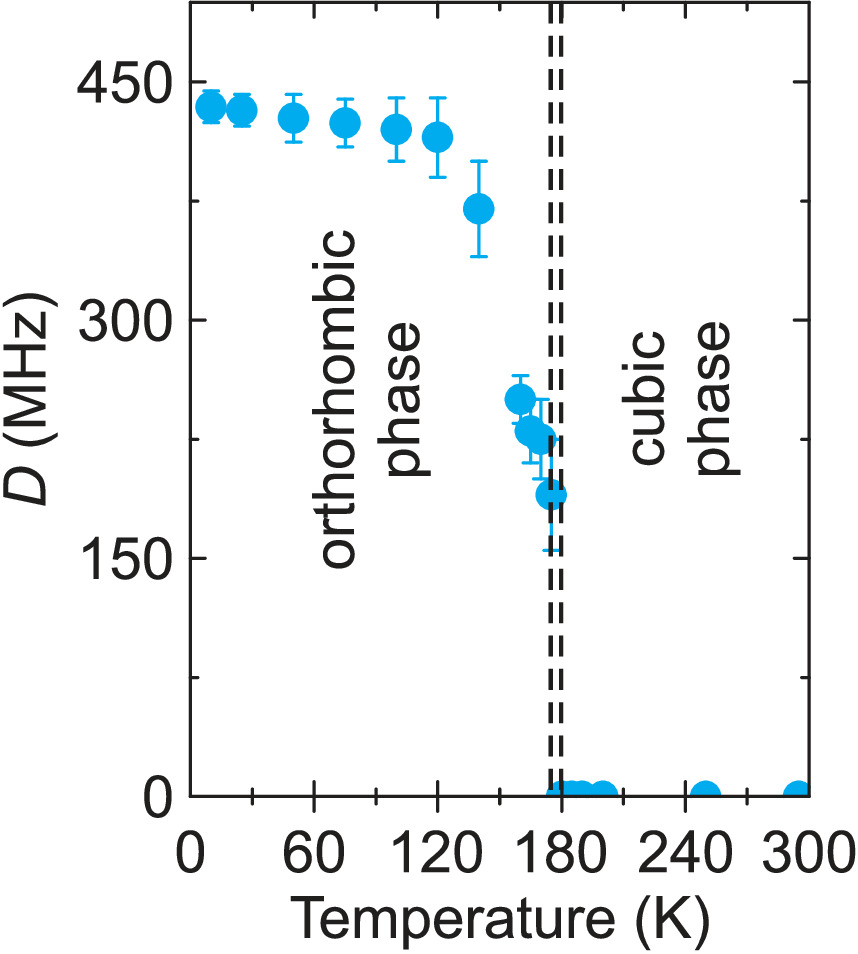
Using pulsed EPR spectroscopy, studying the temperature dependence of the \(_1\) relaxation time and the decoherence time \(_2\) of the Mn\(^{2+}\) centers in MAPbCl\(_3\), we found that \(_1\) is governed by the direct process and the Raman process due to optical phonons. We relate the obtained phonon energy of 59(4)~cm\(^{-1}\) to the dynamics of the inorganic framework.
This project has been funded by the Research Council of Lithuania (LMTLT) (agreement No. S-MIP-22-73).