In present day, there are several different realisations of quantum technologies, such as superconducting qubits, ion traps, photonic and electron spins. Some of the most promising platforms are electron spin qubits in solid state systems [1,2], offering both long coherence time and accessibility by micro-electronic devices, such as micro-resonators [3], that manipulate spin qubits based on electron paramagnetic resonance (EPR). For full controllability of such qubits, sensitive EPR spectrometers that could produce long variable frequency pulse sequences with arbitrary waveform are necessary. These types of commercial spectrometers already exist, but they have limited functionality and are very expensive.
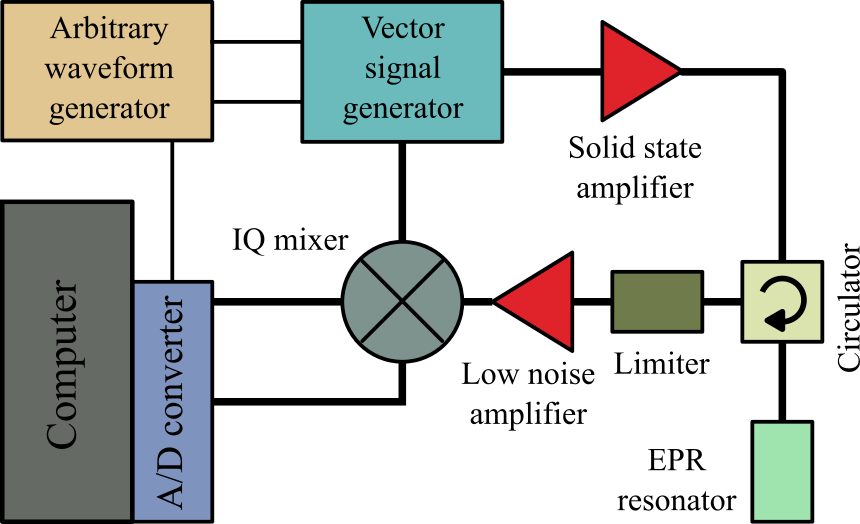
Here, we present a home-built pulsed EPR spectrometer (Fig. 1) operating at 2.5 – 12 GHz frequency range. Microwave excitation is generated using a vector signal generator (R&S SGS100A) with envelope of pulses established by an arbitrary waveform generator (Keysight P9336A) with maximum sample rate of 1.28 GSa/s. The generated pulse sequence is amplified by 25 W solid-state power amplifier. Operation of all devices is controlled using python code. We benchmark the performance of the constructed spectrometer against a standard Bruker E580 EPR spectrometer.
This research was supported by funding from European Union HORIZON-MSCA-2021-PF-01 Marie Skłodowska Curie Fellowship (Project ID: 101064200, SPECTR).