In the past few years materials using thermally activated delayed fluorescence have experienced enormous attention thus allowing organic light emitting diodes (OLED) to reach internal quantum efficiency of 100%\(^{1}\). However commercially viable devices must possess a high external quantum efficiency, which can be achieved by optimizing the OLED’s architecture. Structural refinement is only achievable when the exciton distribution in emitting layer (EML) is known\(^{2}\). It has been shown that by inserting a small amount of emitter that emits in another part of the spectrum it is possible to map exciton location in EML\(^{3}\).
The aim of the research was to show how exciton positions in EML depends on mixed host concentration. Using a well understood green 4CzIPN emitter as pre, a portion of EML would be doped with it. By comparing the green shift of OLED’s spectrum peak to the position of the probe in a mixed host, the exciton distribution will be determined.
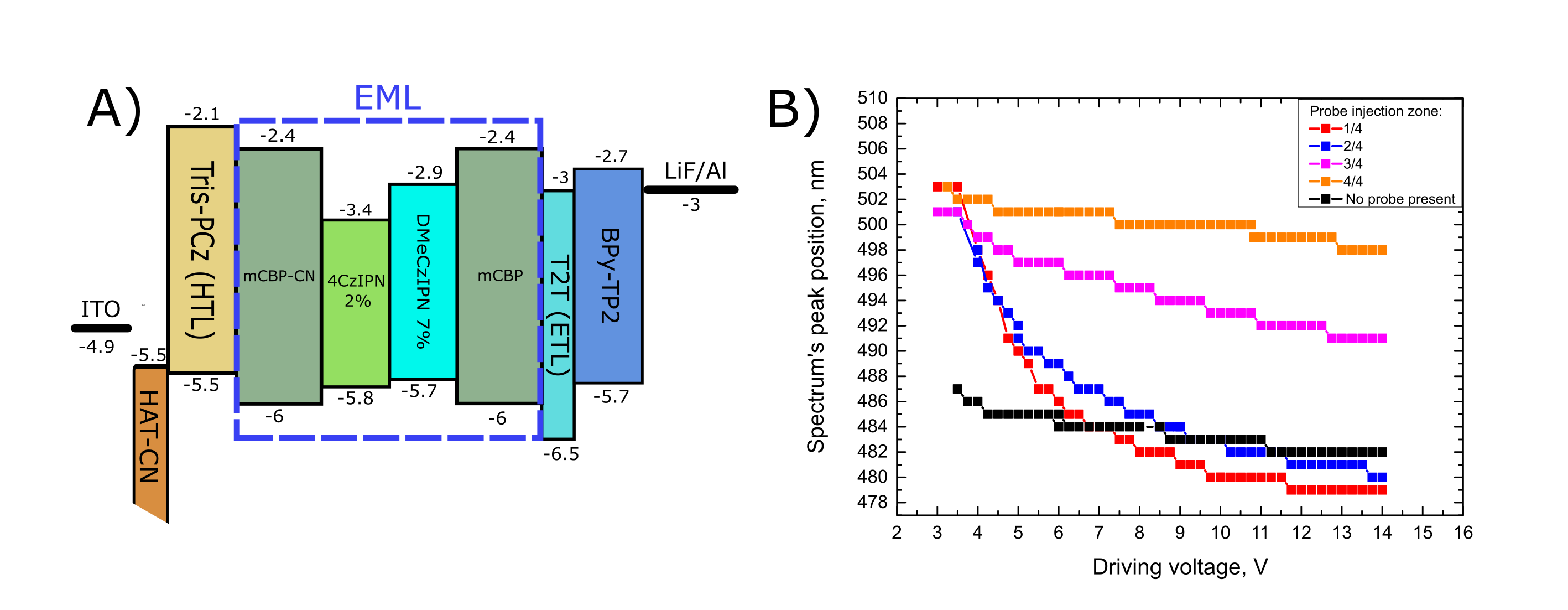
Vacuum-deposited devices had an EML consisting of a mixed host mCBP-CN:mCBP doped with 7% DMeCzIPN emitter and probed with 2% 4CzIPN. The device structure (see Fig. 1) is based on the past work of the scientific group\(^{4}\). OLEDs exhibited EQE up to 19% and the highest brightness up to 130000 \(\text{cd/m}^{2}\) at a current density of 2500 \(\text{mA/cm}^{2}\). The obtained results (see Fig. 1) show that the spectrum peak characteristics depend on the probe’s position. At OLED turn-on, all devices exhibited spectrum peaks around 502 nm wavelength, meaning that the recombination zone is uniformly distributed in the EML. By increasing the voltage, devices with a probe further from the HTL showed a smaller peak shift, indicating that the recombination zone shifted towards the ETL.