Parametric light generators (OPGs) and amplifiers (OPAs) are convenient and simple devices to obtain a wide spectral tuning in the IR region. They are therefore widely used in applications such as spectroscopy, gas detectors, etc. [1, 2]. Some applications require laser radiation of subnanosecond (300 ps - 1 ns) durations at tunable frequencies, but such parametric frequency converters in particular are relatively poorly realized, due to the difficulties caused by the laser-induced damage threshold to the nonlinear medium (LIDT), which, for most materials, is lower than the threshold for parametric generation with subnanosecond pulses. Due to the high nonlinearity coefficient, OPG and OPA are often based on quasi-phase matching crystals, i.e. periodically poled crystals. The fan-out grating design used in this work is characterized by the fact that the grating periods change uniformly over the entire length of the crystal, which enables obtaining a uniform tuning of the wavelengths simply by translating the crystal. This tuning method is superior to temperature tuning because it is simpler, faster, and more reliable.
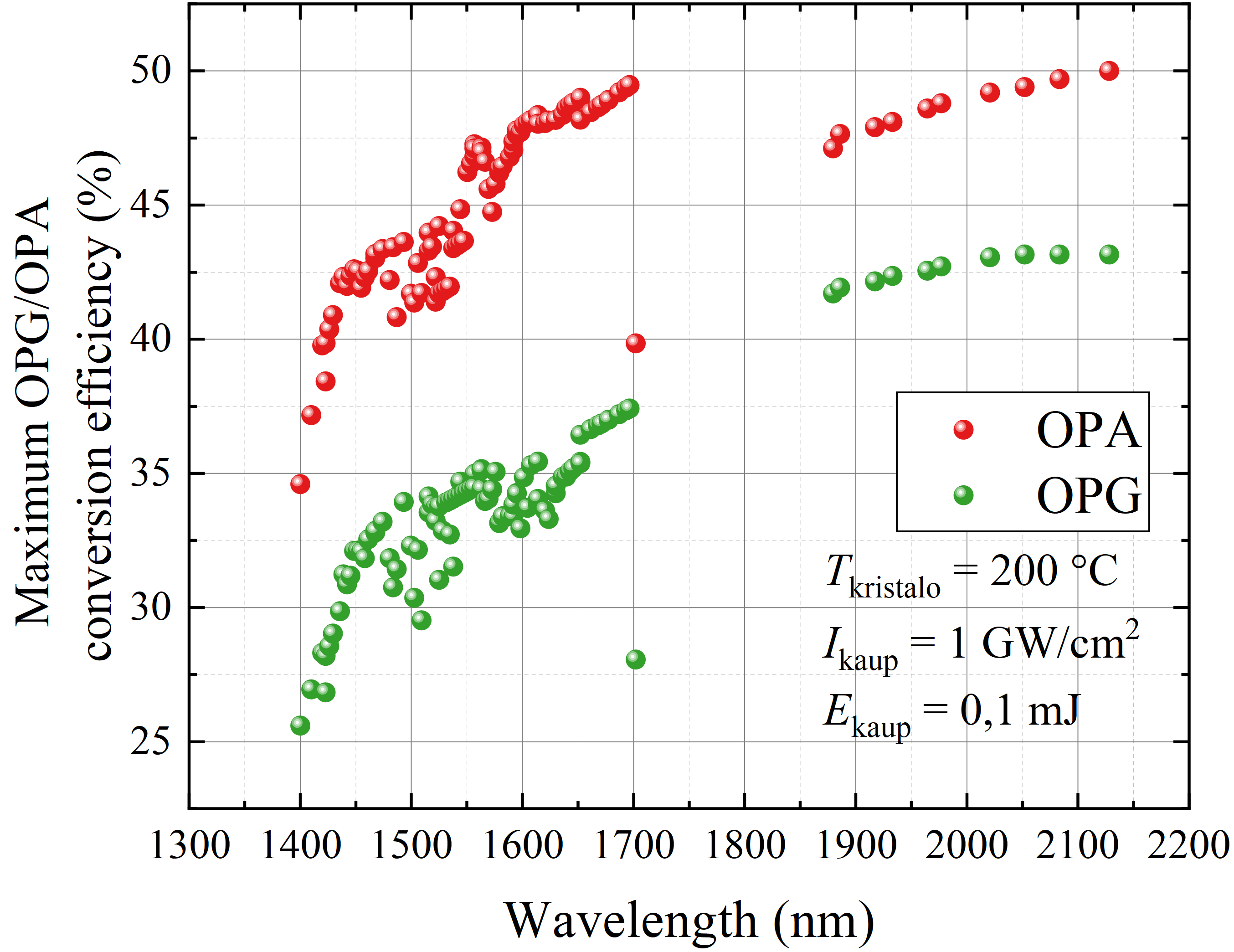
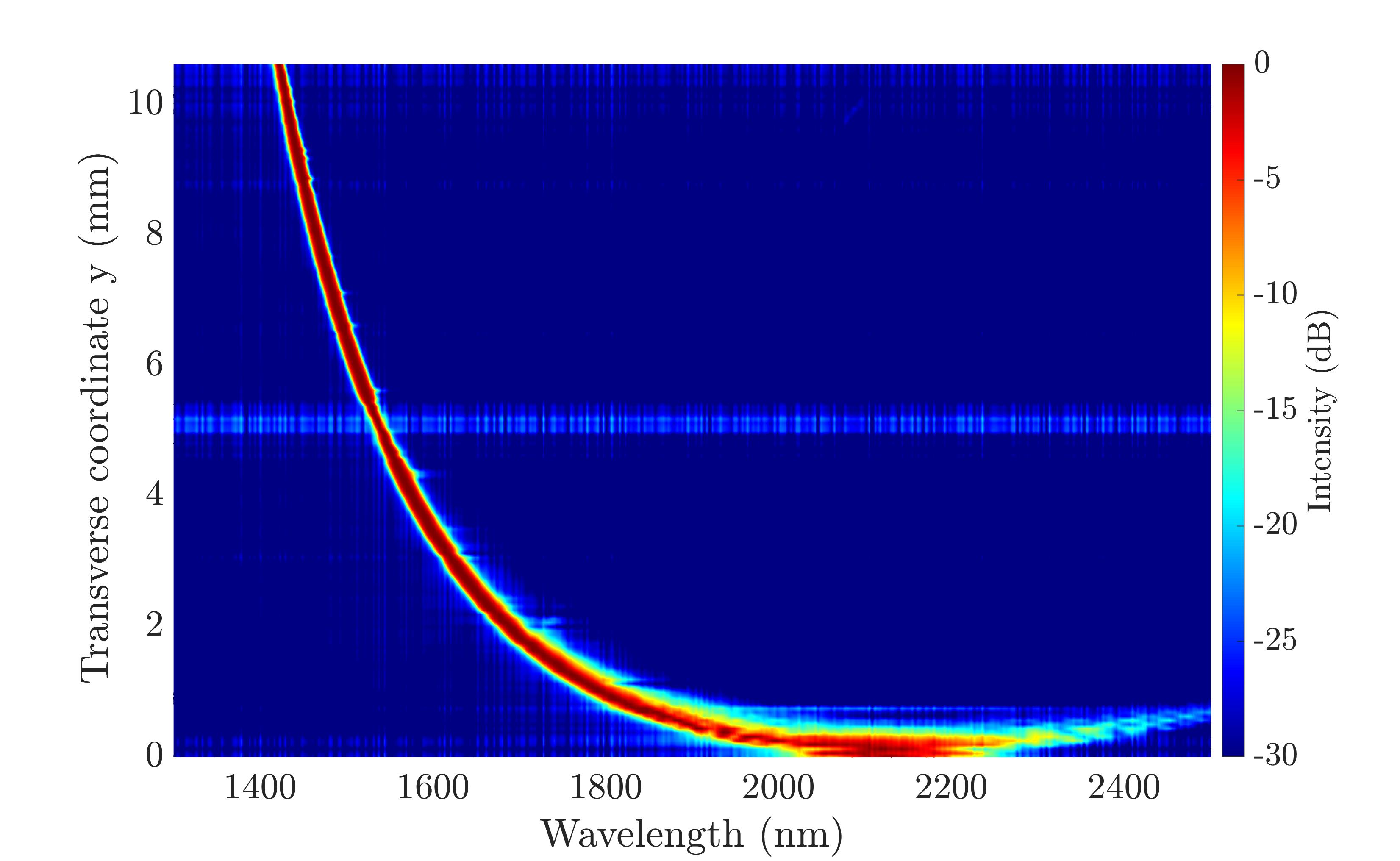
The aim of this study was to construct an optical parametric amplifier with a 25 mm in length fan-out grating design MgO:PPLN crystal, whose grating period changes continuously from 27,5 \(\mu\)m to 31,6 \(\mu\)m. The crystal was pumped by passively Q-switched Nd:YAG MOPA microlaser generating 1064 nm subnanosecond pulses with an average power of 1 W, a pulse duration of 520 ps, and a repetition rate of 1 kHz. As a seed, we used a continuum generated by photonic crystal fiber. The optimal pumping conditions were estimated and the energy and spectral characteristics of the device were investigated. A maximum conversion efficiency of 45% for OPG and 51% for OPA in the degeneracy region was achieved (Fig. 1). It was found that with such grating periods of the MgO:PPLN fan-out grating design crystal and in the cases of both OPG and OPA, we can obtain uniform wavelength tuning in the range of 1420 nm to 2128 nm (Fig. 2) at a crystal temperature of 200 ℃.