
In recent years, the greatest success has been made in achieving high-efficiency triplet-triplet annihilation-based upconversion (TTA-UC) within the visible region. The potential applications are spread over a wide range of fields, including photocatalysis, UV light-induced photosynthesis, and even enhanced security features for documents. Despite these advancements in the visible spectrum, the pursuit of systems demonstrating high efficiency in converting visible (VIS) to ultraviolet (UV) light poses an ongoing challenge.
In TTA-UC two triplet excitons energies are combined to create one, higher energy singlet exciton state. TTA-UC systems consist of two molecules. Sensitizer molecule, which absorbs light strongly in the VIS region and generates triplets through intersystem crossing. Annihilator molecule, which fuses triplet energies together and generates singlet excitons. Here, Ir-C molecule and CBDAC are used as sensitizers while PPO is used as the annihilator.
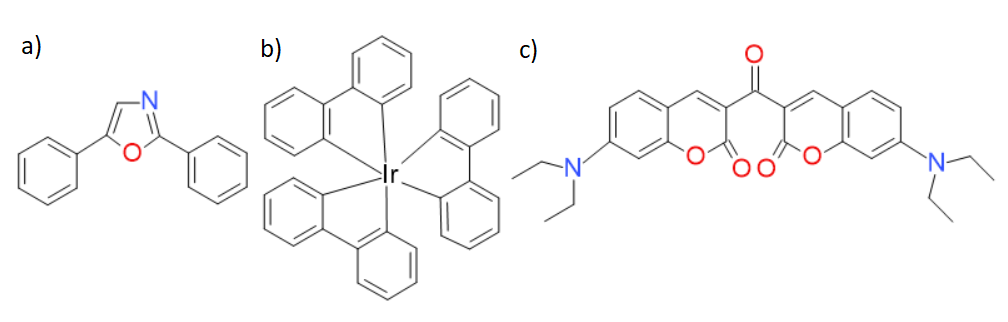
This work aimed to characterize the photophysical properties of PPO&Ir-C and PPO&CBDAC systems. Parameters like upconversion lifetime, fluorescence efficiency, upconversion efficiency and upconversion excitation threshold were measured to determine the statistical probability of PPO. Utilizing PPO as an emitter and Ir-C as a sensitizer in a photon upconverting solution, a concentration of PPO of 10 mM and Ir-C of 0.1 mM was identified as the optimal system, yielding the highest upconversion efficiency. The obtained results reveal a notably high threshold level (182.7 W/cm\(^2\))) while an upconversion quantum efficiency (UCQY) of 2.4 % shows that Ir-C is not a suitable sensitizer as the UCQY is way lower compared to other systems employing PPO with different sensitizers. One of the reasons for the poor performance of this system could be the short lifetime of 1.5 us in Ir-C. CBDAC, however, shows a triplet lifetime of 21.8 us [1] which enhances the efficiency of the system.