
Over the past few years pressurized pharmaceutical technology has been rapidly advancing. Pressurized dosage forms offer advantages over other forms such as convenience and hygiene of application, high efficient at relatively low drug substance costs. From literary sources it is known that depending on amount of propellant in container consumer properties such as spot size, case of application and percentage of concentrate released front aerosol container depend on amount of propellant. Our research focused on justifying concentration of chosen propellant - a combination of saturated hydrocarbons (propane, butane, isobutane). The aerosol cans with a capacity of 200 ml were filled with a pre-made concentrate solution of 93 g sealed with continuous-action valves, and a mixture of propane, butane and isobutane (45:50:5) was added to aerosol can. The amount of mixture ranged from 15% (29.75 g) to 20% (40.25 g) of aerosol can. The concentration increase step was 5%. To choose optimal concentration of propellant, we investigated its impact on technological indicators of aerosol: dispensing type, appearance, thickness, drying time, spot size, and percentage of content released from can. The results are presented in Table 1. 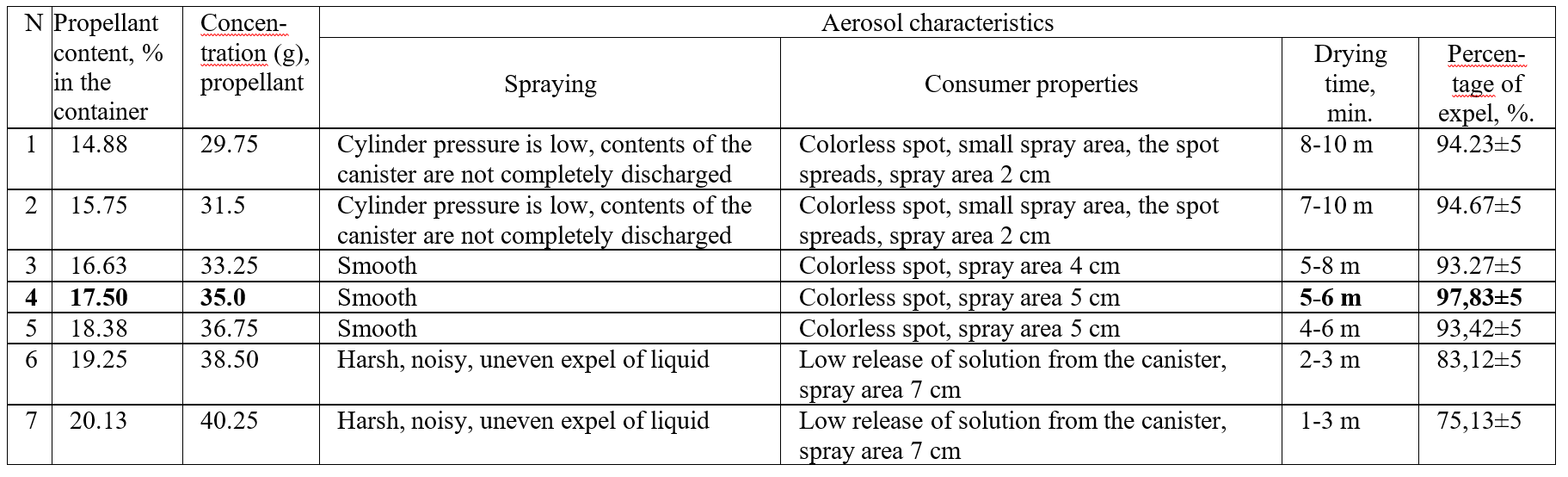
Based on the conducted research, it can be asserted that type and quantity of propellant significantly influence atomization process. Regarding the dispensing type and external appearance of the spray formed from samples containing a mixture of propane, butane, and isobutane (17.5%), it was observed to be colorless with a smooth shiny surface and a smooth dispensing type. It was found that an increase in concentration of propellant from 15 to 20% results in an increase in amount of sprayed solution. This, in our opinion, is associated with type of aerosol dispensing, an increase in percentage of gaseous phase, and a decrease in solution’s density. However, as thickness of spray spot increases, drying time also increases. The latter, in turn, is related to indicator of p̈ercentage of content released from the aerosol container.̈ It has been proven that an increase in amount of propellant from 19 to 20% leads to a decrease in percentage of content released from cans to 83.12±5%. Further increase in propellant results in a gradual reduction of this indicator.
Therefore through comparative analysis was established that optimal choice is use of a propellant mixture of propane, butane and isobutane (45:50:5) at a concentration of 17.5%.