Over the past few years, research and technology in the field of terahertz (THz) radiation has developed significantly. This is due to the non-ionising properties of this radiation, characterised by a much longer wavelength than that of the visible range. Applications of this radiation are increasingly being found in fields such as medicine, biology or safety. It is therefore a motivation to continue research into spatial filtering, with suitable personalised optical elements to enable imaging of transparent elements in this frequency range.
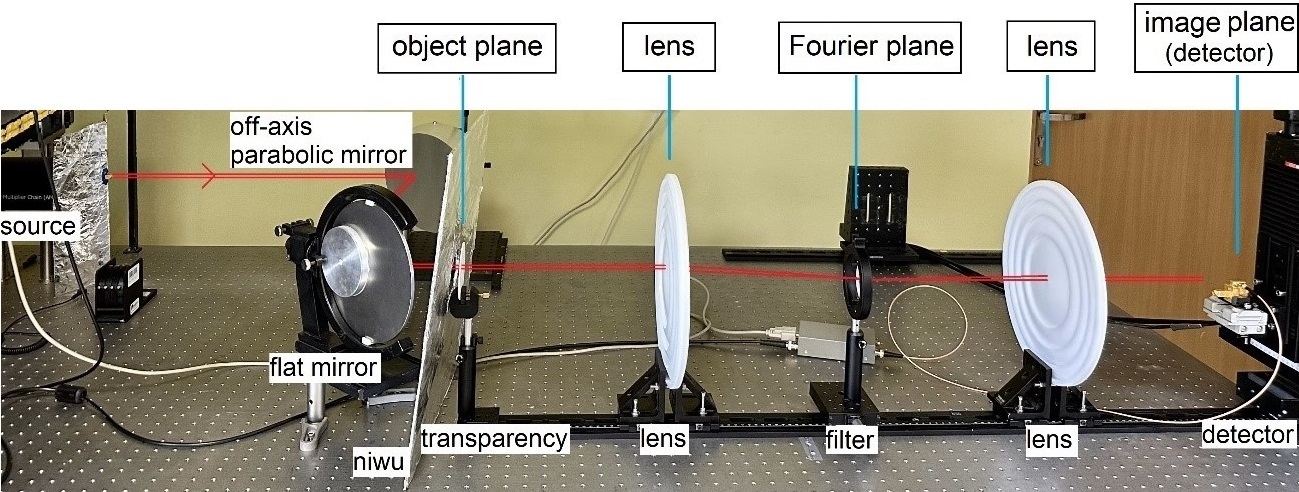
Spatial filtering method is a promising technique, that can be used to visualize transparent objects with the use of a 4f optical setup (Fig.1) with much larger apertures than in the previous research [1].
It was decided to focused on two of the main spatial filtering methods. The first is the Positive Phase Contrast (PPC) method, which allows imaging after the insertion of a phase filter introducing a phase delay of \(\pi\)/2 into the setup in the focal plane. The second method used is the Negative Phase Contrast (NPC) method, which uses phase filters introducing a phase delay of 3/2 \(\pi\), thus obtaining an image opposite to that obtained using the PPC method. The choice of these methods is due to the linear relationship between the received irradiance in the image plane and the phase shift introduced by the object in the input [1].
After performing relevant simulations to find proper sizes of filters, it was procced with analysis of suitable materials from which optical object could be made. It was important to find materials with a relatively low refractive index and a low absorption coefficient, so that obtained objects were transparent at the chosen frequency [2] and possible to manufacture by FDM method in 3D printing [3].
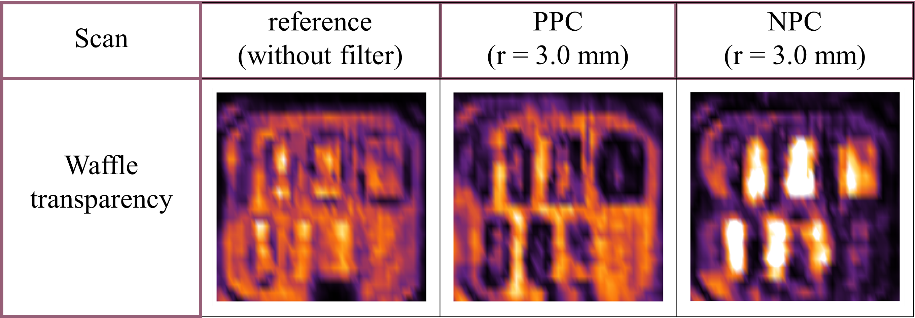
The experiment confirmed the performance as well as proved the suitability of this method in the THz range, the effects of which can be seen in Fig. 2. It also showed some unexpected effects associated with very long wavelengths, which inspired further research.