The main characteristic of RV Tauri type variable stars is the presence of pulsation caused alternating deep and shallow minima in their light curves. Many of these stars possess a peculiar photospheric abundance pattern called depletion – those chemical elements that have high dust condensation temperature are systematically underabundant. The peculiarity is generally thought to be caused by re-accretion of gas from a dusty disc [1]. This surrounding structure causes IR excess in spectral energy distribution of RV Tauri type objects. Indeed, depletion has been observed mainly for those stars that have IR excess; however, there are a few depleted ones that show no excess [2]. Probably for these latter objects the disc, that caused the depletion, has dissipated. Evolution of discs surrounding RV Tauri type stars and other related objects is very poorly understood.
We have observed spectra of 11 RV Tauri type stars that have no IR excess with the main goal of searching for depletion patterns. The observations were carried out with the high-resolution Fiber-fed Echelle Spectrograph (FIES) at the Nordic Optical Telescope and Vilnius University Echelle Spectrograph (VUES) at the 1.65-metre telescope in the Molėtai Astronomical Observatory. Here we present first results of spectroscopic analysis for five of the observed stars: V399 Cyg, V894 Per, AA Ari, HD 172810, and V457 Cyg.
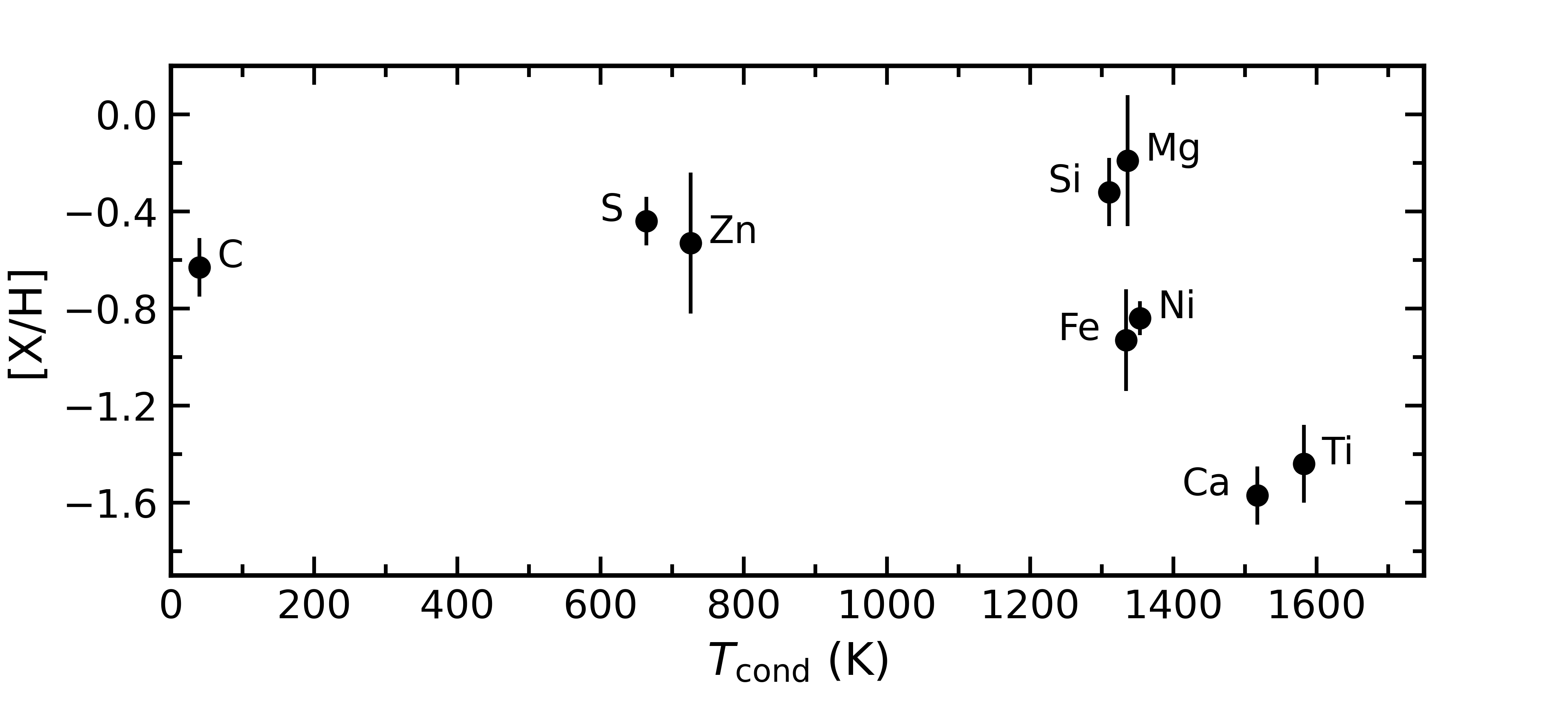
We identify absorption lines of multiple chemical elements in the spectra and measure their equivalent widths. These are used to derive photospheric parameters and chemical element abundances. The calculations are done by using the code SPECTRUM [3] and ATLAS model atmospheres [4]. Photospheric parameters are determined by employing the method of excitation and ionization balance for iron lines. Derived effective temperatures are in range of 4000 to 8000 K, surface gravities are no higher than log g = 2.5 and iron abundances range from [Fe/H] = -1.5 to +0.3. Only in the case of V457 Cyg, the abundance pattern indicates depletion (Figure 1).