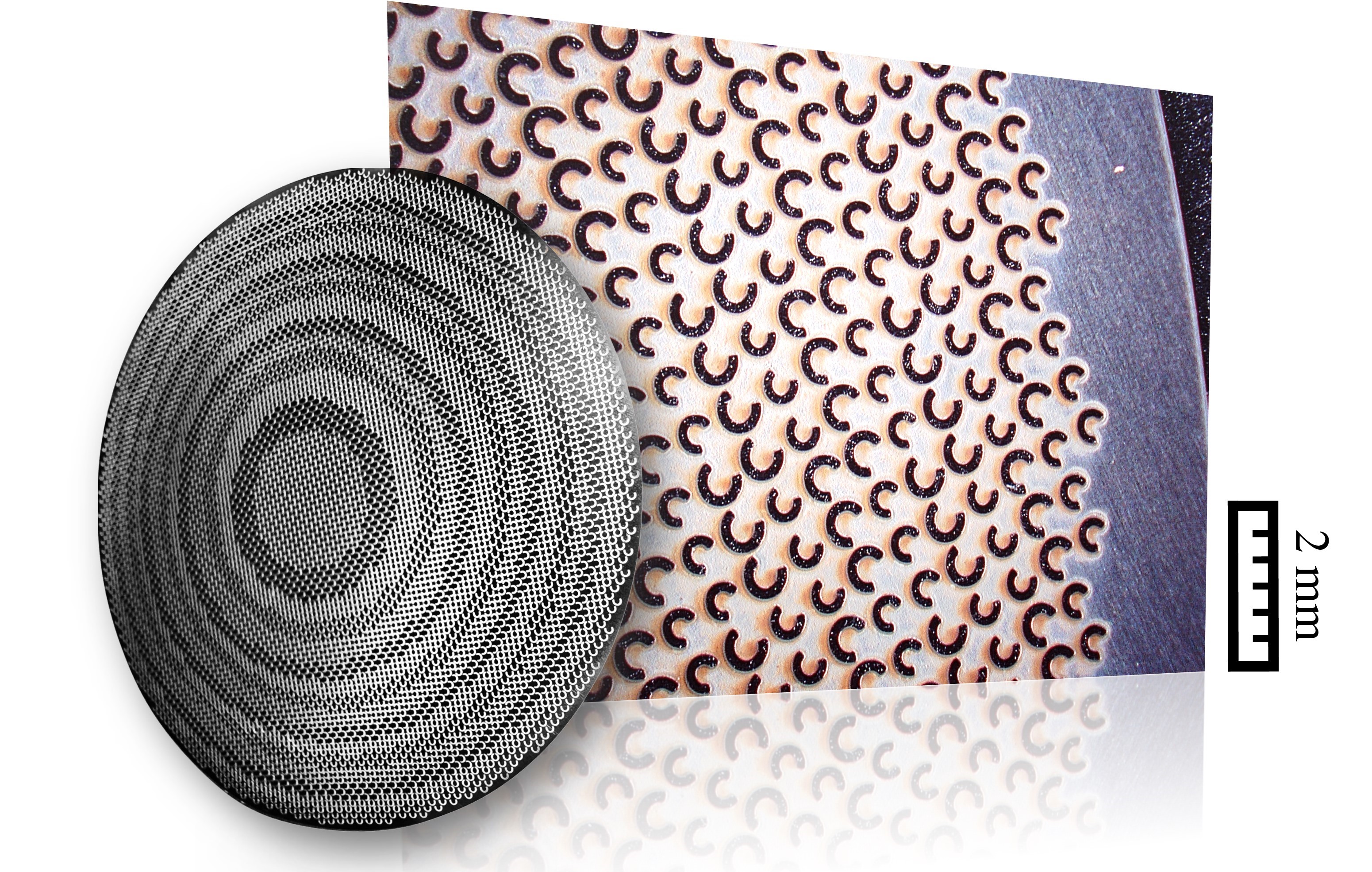
Split-ring resonator (SSR) based metasurface lenses have been a topic of active research in terahertz science [1]. Metasurface lenses offer several advantages over conventional lenses, including compactness, tunability and are employed for terahertz wavefront engineering [2]. In this study, we investigated the beam shaping capabilities of five different SSR designs with varying geometries.
The lenses were fabricated from 25 \(\mu\)m stainless steel foil using laser ablation [3]. Beam profiles were measured along the XZ and XY planes to evaluate the focusing capabilities along the optical axes in a focal plane.
Our results demonstrate that a specific paraxial design with four sub-zones employing two distinct SSR geometries (C03) exhibited best beam focusing performance compared to other lenses, achieving the smallest focus point of FWHM equal to \(\sim\)1.5 mm and highest amplitude \(\sim\)0.14 V at focal point. In contrast, C05 with a two-subzone design, had the poorest focusing performance, with a focal point of FWHM equal to \(\sim\)1.74 mm and the lowest amplitude of \(\sim\)0.063 V. Additionally, C04 had the largest FWHM of \(\sim\)12.70 mm along the z-direction, indicating the broadest beam profile in z-direction among all five designs. C06, a non-paraxial design, demonstrated an amplitude of \(\sim\)0.11 V and an XY plane FWHM of \(\sim\)1.6 mm and was the second best lens for focusing after C03.
Understanding the intricacies of these metasurface lenses is crucial for advancing terahertz technology, opening up avenues for applications that leverage their unique properties, such as enhanced imaging, communication [4,5].
This research has received funding from the Research Council of Lithuania (LMTLT), agreement No [S-MIP-22-76].