
Hydrogels are polymeric materials capable of absorbing and holding a large amount of water without dissolving in it, have increased sorption properties, biocompatibility, and biodegradability, which makes them attractive for use in the biomedical field, agriculture, and other industries [1]. The addition of montmorillonite-type clay increases mechanical strength of hydrogels, forms a network of connections, which improves structural properties and makes them more resistant to deformations [2]. This is important for the use of such materials in technologies where high strength is required [3]. The purpose of this work is to develop the technology for obtaining hybrid hydrogel materials based on the polymer composition of polyvinyl alcohol (PVA) with the addition of carboxymethylated starch (CMS) and montmorillonite-type clay and to study their sorption properties.
The paper proves the possibility of obtaining hybrid hydrogels by the cryostructuring method based on a mixture of PVA:CMS polymers in a 1:1 ratio with the addition of montmorillonite type clay (M-5). It was established that compositions with the clay component content below 8 parts by volume form a stable structure of the hydrogel material. In the work, the swelling of samples of the filled hydrogel matrix in distilled water was investigated and the sorption properties were determined by the gravimetric method.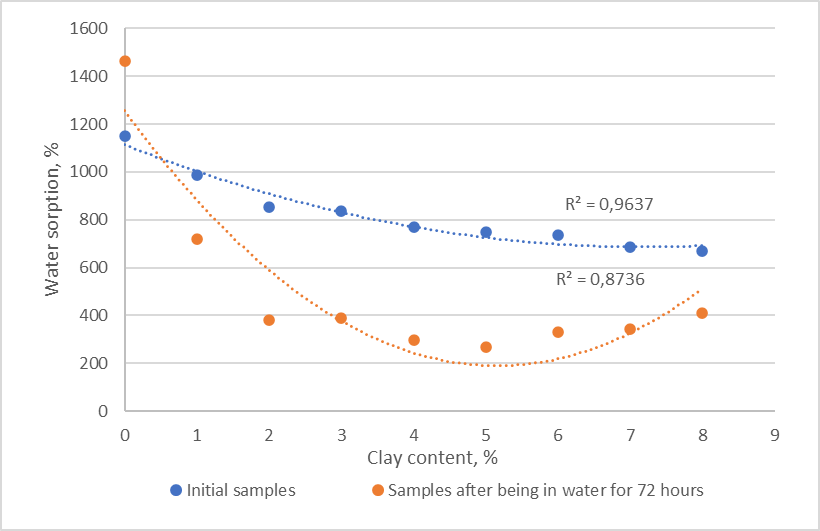
It was established that the clay-filled hydrogel systems collapse, reaching the equilibrium value of sorption within 72 hours. For samples containing 1 volume part of clay, sorption decreases by 270 % and is 720 % in the equilibrium state. The maximum decrease in sorption by 480 % is observed for samples that contain 5 volume parts of clay and is 300 % in the equilibrium state. When studying the desorption of hybrid hydrogel materials, it was established that the addition of montmorillonite-type clay slows down the process of hydrogel desorption. At the same time, the maximum desorption rate is observed during the first 5-7 hours of the experiment for all samples, and is on average 60 % / h for the sample that does not contain clay, and 30 % / h for samples containing montmorillonite clay.
Thus, polymer compositions based on PVA:CMS in a 1:1 ratio with the addition of montmorillonite-type clay in the amount of 1-2 parts by volume can be recommended for obtaining cryohydrogels with increased sorption properties and slower drying speed.