
S100 proteins are calcium-binding proteins that regulate several processes associated with Alzheimer’s disease (AD) but whose contribution and direct involvement in disease pathophysiology remains not fully established. Due to neuroinflammation in AD patients, the levels of several S100 proteins are increased in the brain and some S100s play roles related to the processing of the amyloid precursor protein, regulation of amyloid beta peptide levels and Tau phosphorylation [1]. The number of studies on the impact of S100 family proteins in co-aggregation processes with amyloid-like proteins is increasing. However, research has yet to unravel how S100 proteins interact with neuronal membranes. The present study is focused on the pro-inflammatory calcium-binding protein S100A8 of the S100 family. We employ various biomimetic membrane models such as solid supported lipid bilayers, tethered bilayer lipid membranes and liposomes to monitor the interaction between S100A8 protein and membrane surface. For this purpose, we employed high speed atomic force microscopy (HS-AFM), fluorescence spectroscopy and electrochemical impedance spectroscopy techniques. Our results indicate that the interaction between S100A8 and the membrane is lipid-charge sensitive. The greatest membrane disruptive effect is observed in negatively charged membranes. HS-AFM data reveals that the interaction of S100A8 with negatively charged bilayer leads to the rupture of the membrane by a detergent-like effect (Fig. 1). These results might broaden the understanding of S100A8 protein interactions with neuronal membranes and potentially affect the development of new diagnostic and therapeutic approaches for AD or other related diseases. 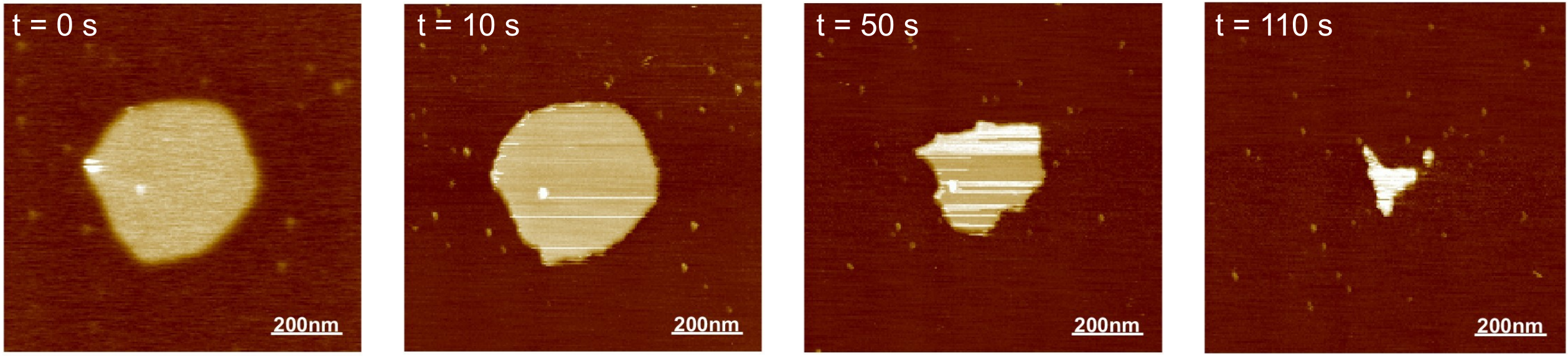
S100A8 PROTEIN INTERACTION WITH LIPID MEMBRANES
Rimgailė Tamulytė1, Darius Šulskis2, Marija Jankunec1
1 Institute of Biochemistry, Life Sciences Center, Vilnius University, Vilnius, Lithuania
2 Institute of Biotechnology, Life Sciences Center, Vilnius University, Vilnius, Lithuania
Fig. 1. HS-AFM images of S100A8 induced membrane dissolution. At t = 0, the protein was injected in the fluid cell during imaging. Interaction between S100A8 and negatively charged membrane leads to a detergent-like effect.
[1] J.S. Cristovao, C.M. Gomes. S100 Proteins in Alzheimers Disease. Frontiers in neuroscience, 2019, 13, 463.