
Nowadays the world is facing the problem of plastic production. Every year tones of plastic products such as disposable diches, bags and device packaging made for daily use. According to the latest data scientists counts that plastic production amounts are increasing every year. Figure 1 shows that in the 2022 plastic amount reached 400 Mt. per year. A major part of plastic is fossil based and only a relatively small part of plastic is recycled or made into bioplastic [1].One type of plastic is microplastic whose particles size ranges from 5 mm to 1 µm. Microplastic particles dumped into freshwater systems: rivers, lakes, and oceans. In the environment these particles cause ecological and health protection problems. Various technologies are used for microplastic particles removal one of them is sorption. It is known that for sorbents synthesis can be used natural resources such as biomass wastes from industry. In this study from softwood sawdust was extracted lignin by alkali extraction method. Nanosorbent was synthesized from lignin and iron oxide magnetic nanoparticles. The sorption was evaluated by sorbing low-density polyethylene (LDPE) particles. After sorption microplastic particles was remove by external magnetic field. In this study the main step was investigate sorption process dependence by various parameters impact to LDPE removal efficiency. In this work it was showed, how solution pH, sorption time, sorbate concentration, sorbent dosage affects to removal efficiency.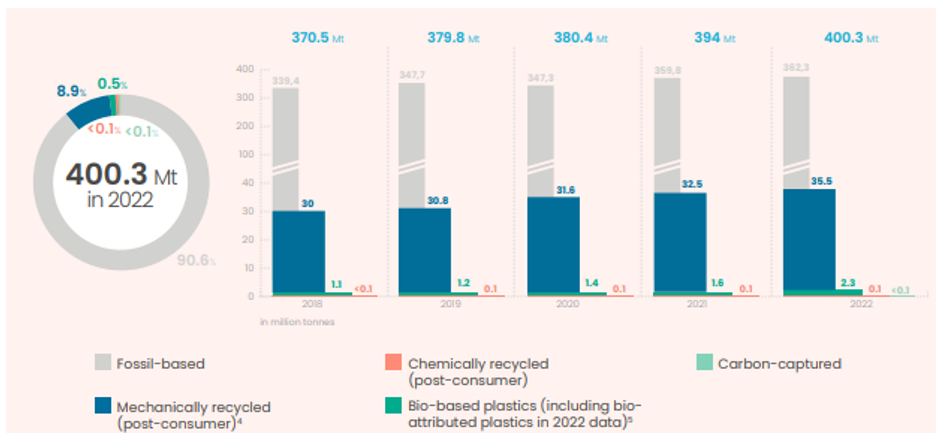
STUDY OF DIFFERENT PARAMETERS IMPACT TO MICROPLASTIC REMOVAL FROM WATER USING LIGNIN-MAGNETITE NANOSORBENT
Austėja Burbulytė1, Ieva Uogintė1, Vaidas Pudžaitis2
1 Center for Physical Sciences and Technology, Department of Environmental Research, Saulėtekio av. 3, LT-10257 Vilnius
2 Center for Physical Sciences and Technology, Department of Organic Chemistry, Saulėtekio av. 3, LT-10257 Vilnius
Fig. 1. Plastic production rates [1]
Acknowledgments: The project is co-financed from the funds of the European Social Fund (project No. 09.3.3-LMT-K-712-23-263) under grant agreement with the Research Council of Lithuania (LMTLT).
[1] Plastics Europe, Plastics the fast facts, (2023-1)