In the last decade organic light emitting diodes (OLEDs) that employ thermally activated delayed fluorescence (TADF) emitters have been extensively investigated due to the ability to achieve nearly 100% internal quantum efficiency [1]. Unlike red and green, blue OLEDs still lag in long-term stability [2]. Recently, a method of using a mixed-host system in the emissive layer has been proposed, resulting in higher device efficiency, slower roll-off and better stability than its single host equivalent [3].
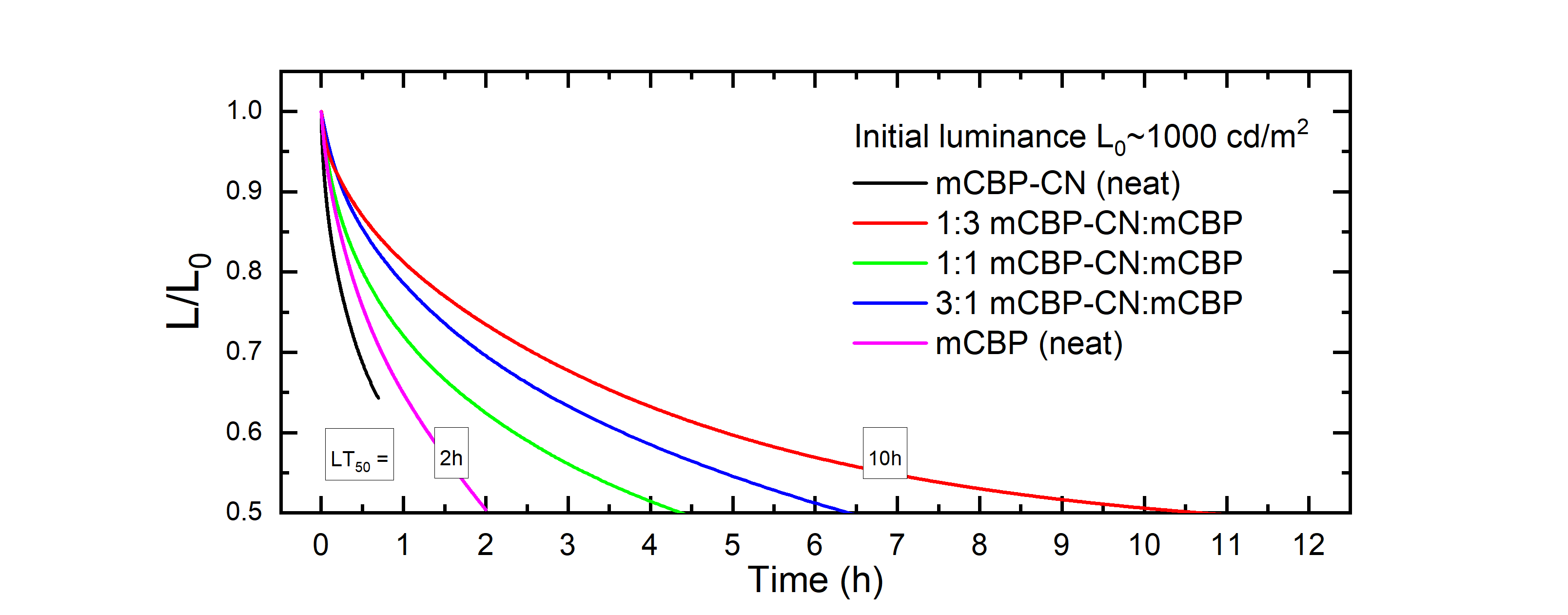
This work aims to show an increase in blue DMeCzIPN emitter-based OLEDs’ efficiency and lifetime when using a mixed-host emissive layer. Devices were fabricated through vacuum deposition in five batches utilizing widely used OLED host materials mCBP and mCBP-CN. Each emissive layer comprised a different ratio of the host materials doped with 7% DMeCzIPN emitter. The optimal host ratio was determined to be 3:1 for mCBP to mCBP-CN, resulting in up to 18.8% external quantum efficiency (EQE), whereas neat mCBP host devices only exhibited EQE of 9.8%. In terms of stability, the LT\(_{50}\) time (the loss of initial brightness L\(_0\) by half) at L\(_0\sim\)1000 cd/m\(^2\) was determined to be around 10h for the optimal mixed-host ratio device and around 2h for the neat mCBP host device (see Fig. 1). The substantial increase in efficiency and prolonged stability suggests that selecting appropriate host materials and choosing the optimal ratio for the emissive layer can advance the research of blue TADF OLEDs, unlocking their full potential for commercial application.