Hydrogen peroxide (H\(_2\)O\(_2\)) is a widely utilized compound in laboratories, serving various purposes such as: an oxidizing agent, a reagent, or a cleaning/disinfecting agent. Unfortunately, the compound exhibits degradation, particularly in highly concentrated solutions, even at low temperatures. Traditional methods for assessing its concentration, such as titration, are time-consuming and require additional reagents.
To address this issue, an electrochemical sensor can be used to measure the concentration of H\(_2\)O\(_2\) in solutions. In this study, a multilayer capacitor was employed as the sensing element due to its low cost of manufacturing, small physical size and compatibility with electronic systems.
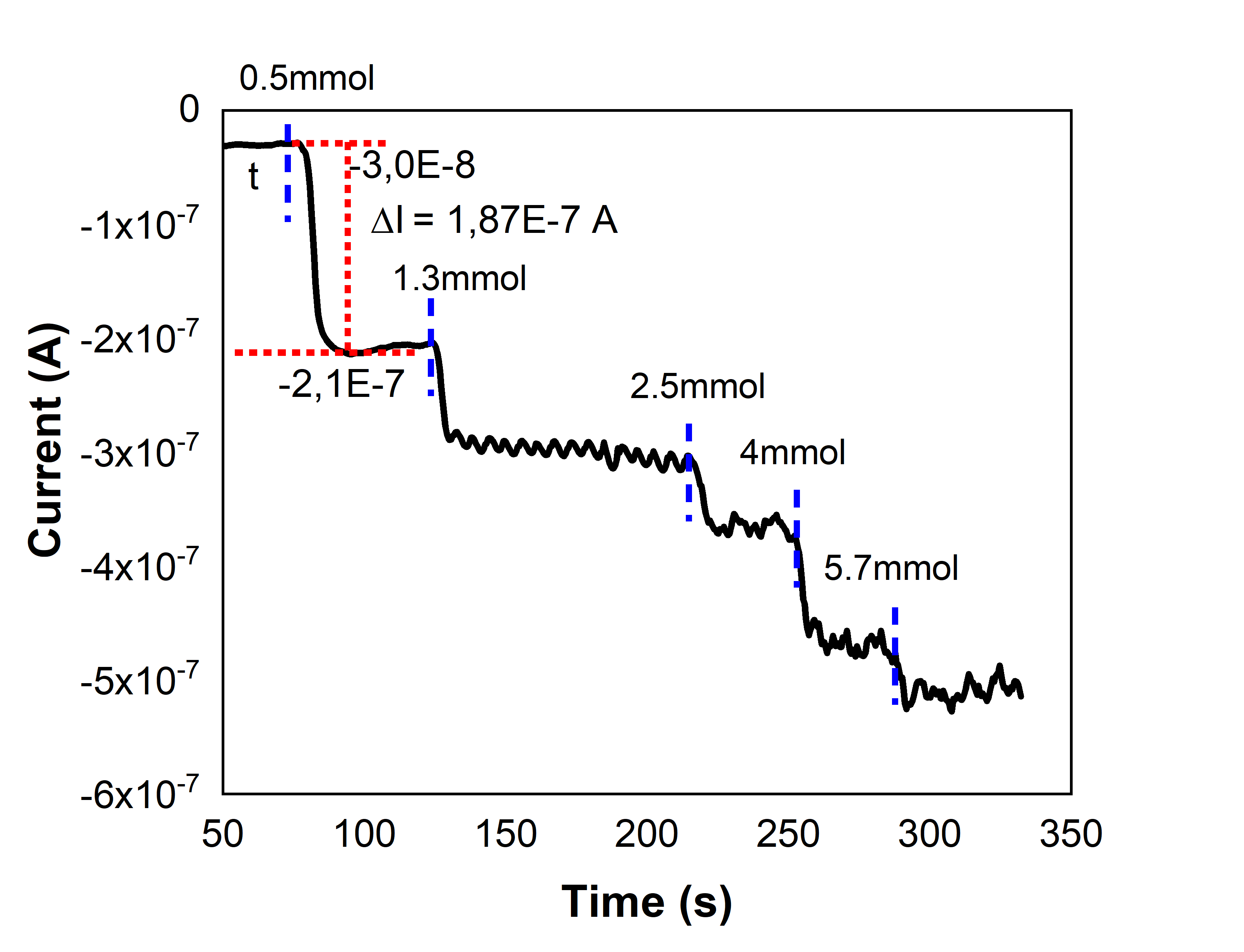
Chronoamperometric measurements were performed using a three-electrode system, applying a potential of +0.3 V and introducing H\(_2\)O\(_2\) concentrations ranging from 0.5 mmol to 5.7 mmol. The acquired chronoamperogram demonstrated distinct changes in the amperometric signal with each addition of H\(_2\)O\(_2\).
Using a multilayer capacitor, electrochemical measurements were successfully conducted in the solution. The resulting amperometric signal exhibited a linear dependence on the concentration of H\(_2\)O\(_2\), with a determined sensitivity of 3.46E-7 A/mM. This electrochemical sensing approach offers a rapid and efficient means of quantifying H\(_2\)O\(_2\) concentrations, presenting a valuable alternative to traditional titration methods.