
Food safety is a global concern, posing health risks to consumers and economic losses for the food industry due to potential contamination\(^{1}\). Another noteworthy problem is the rising resistance of microorganisms to antibiotics and antimicrobial technologies. However, antimicrobial photodynamic inactivation (API) shows promising results in inactivating microorganisms\(^{2}\). API uses photosensitizer (PS), light, and molecular oxygen. When PS absorbs a quantum of light it generates reactive oxygen species (ROS) through molecular interactions with oxygen in the surrounding environment\(^{3}\).
Microorganisms inactivation through ROS activity can be enhanced by change of charges. Natural PSs magnesium chlorophyllin (MgChl) and copper chlorophyllin (CuChl) are anionic compounds, which is why their binding or penetration to the cell is limited. When these PSs are combined with non-toxic cationic chitosan (CHS): MgChl-chitosan (MgChl-CHS) and CuChl-chitosan (CuChl-CHS) (Fig. 1. C, D) complexes can penetrate intracellular space easer and inactive microorganisms more efficiently. The aim of this study is to compare MgChl-CHS and CuChl-CHS complexes photophysical properties to determine which one is more suitable for enhancing API technology effectiveness.
Initially, several primary solutions are prepared in deionized water: 0,01%MgChl-1%CHS and 0,01%CuChl-1%CHS, and for further experiments, these complexes are diluted with 0,9% NaCl and PBS solutions. The final working concentrations are 0,001%MgChl-1%CHS and 0,001%CuChl-1%CHS (Fig. 1. A, B).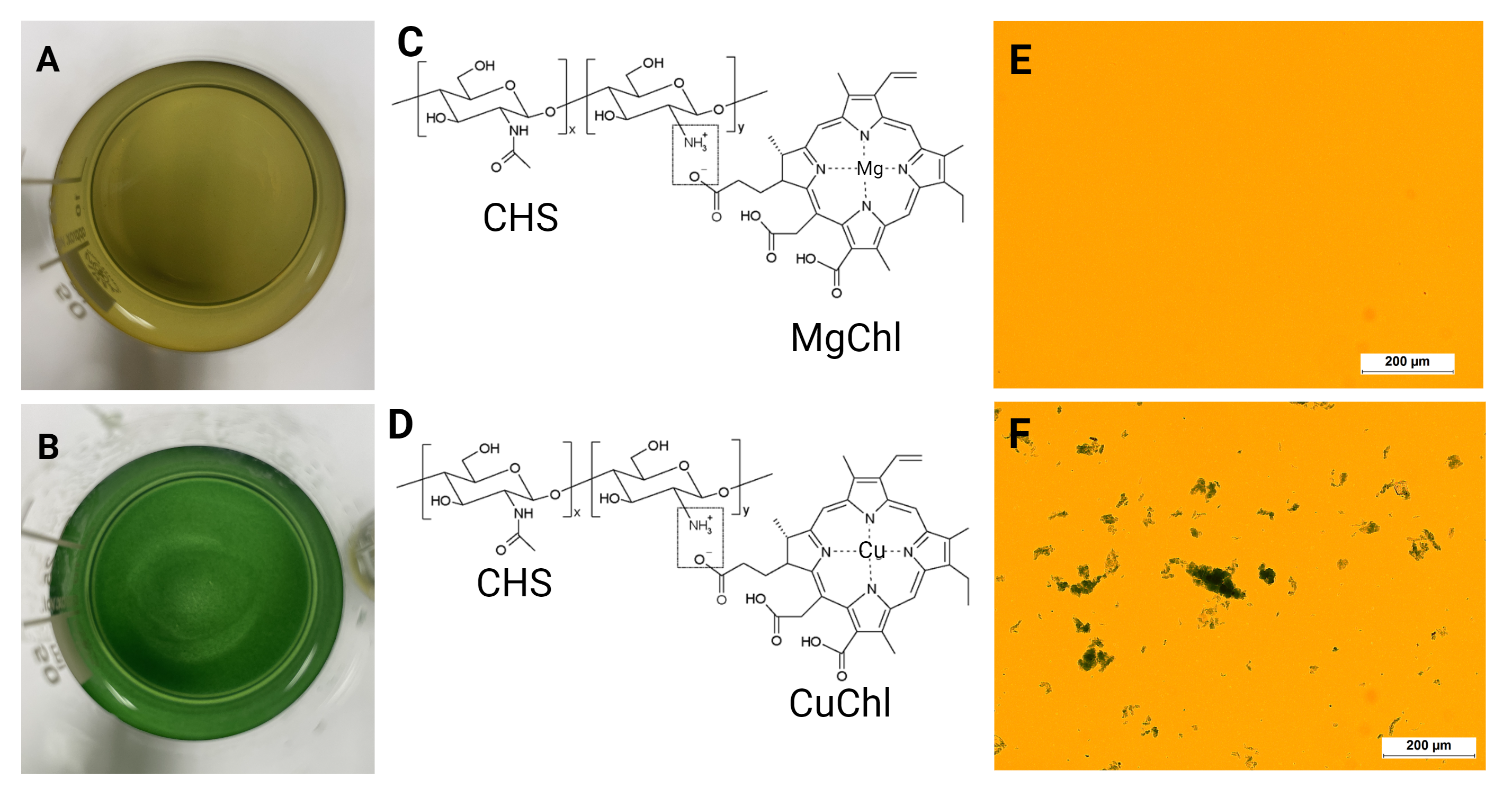
The prospect of this research involves further investigation of the properties of the MgChl-CHS and CuChl-CHS complexes and their antimicrobial effectiveness on microorganisms.
COMPARINGCOPPER AND MAGNESIUM CHLOROPHYLLIN-CHITOSAN COMPLEXES
Gabrielė Vasiliauskaitė1, Irina Buchovec2
1 Department of Neurobiology and Biophysics, Life Science Center, Vilnius University
2 Institute of Photonics and Nanotechnology, Faculty of Physics, Vilnius University
Fig. 1. (A) 0,01%MgChl-1%CHS solution; (B) 0,01%CuChl-1%CHS solution; electron microscope photo of: (C) 0,01%MgChl-1%CHS solution and (D) 0,01%CuChl-1%CHS solution.
[1] FDA, Food and Drug Administration, 2020
[2] I. Buchovec et al. Journal of Photochemistry and Photobiology 172 p.1-10 (2017).
[3] Z. Luksiene et al. Innovative Food Science and Emerging Technologies, 463-472 (2019).