
The information hunger fuels the race for continuous advances in data storage. More than a decade ago, a potential of ultrafast laser writing of isotropic modification for three-dimensional optical memory was demonstrated [1]. Later it was found that the ultrashort laser pulses could also induce anisotropic modifications related to self-assembled nanogratings formation [2]. This anisotropy can be characterized by two independent parameters: retardance and slow axis orientation, which can be rewritten with successive pulse sequences. Recently, it was suggested using these parameters to extend optical recording beyond the three dimensions [3]. As a result, femtosecond laser induced self-assembled nanostructures can be employed as a rewritable five-dimensional optical memory. Here we explore in depth this technology and demonstrate its actual implementation for multidimensional optical recording and reading.
Retardance and slow axis orientation can be independently controlled by number of pulses and azimuth of irradiated light polarization. Recording of information is performed with a mode-locked regeneratively amplified femtosecond laser system PHAROS (Light Conversion Ltd.) operating at $\lambda$ = 1030 nm and delivering pulses of 270 fs at 200 kHz repetition rate. Laser beam is focused with a high-NA lens into the bulk of a fused silica sample mounted on a three-axial motion platform controlled with the SCA software (Altechna Ltd.). A successive reading of the recorded information is performed with a quantitative birefringence measurement system (Abrio, Cri Inc.) based on a conventional optical microscope Olympus BX51.
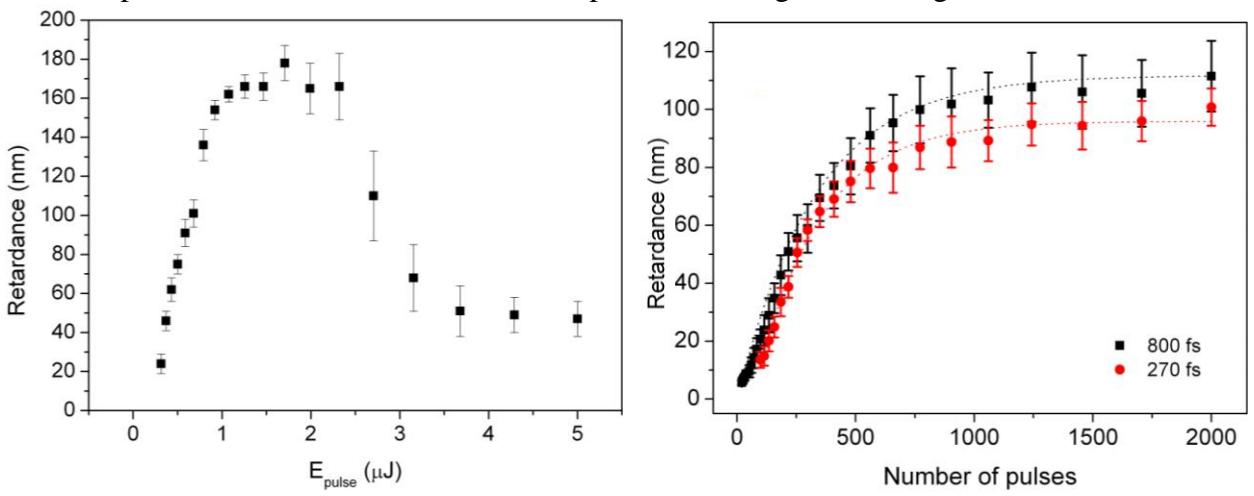
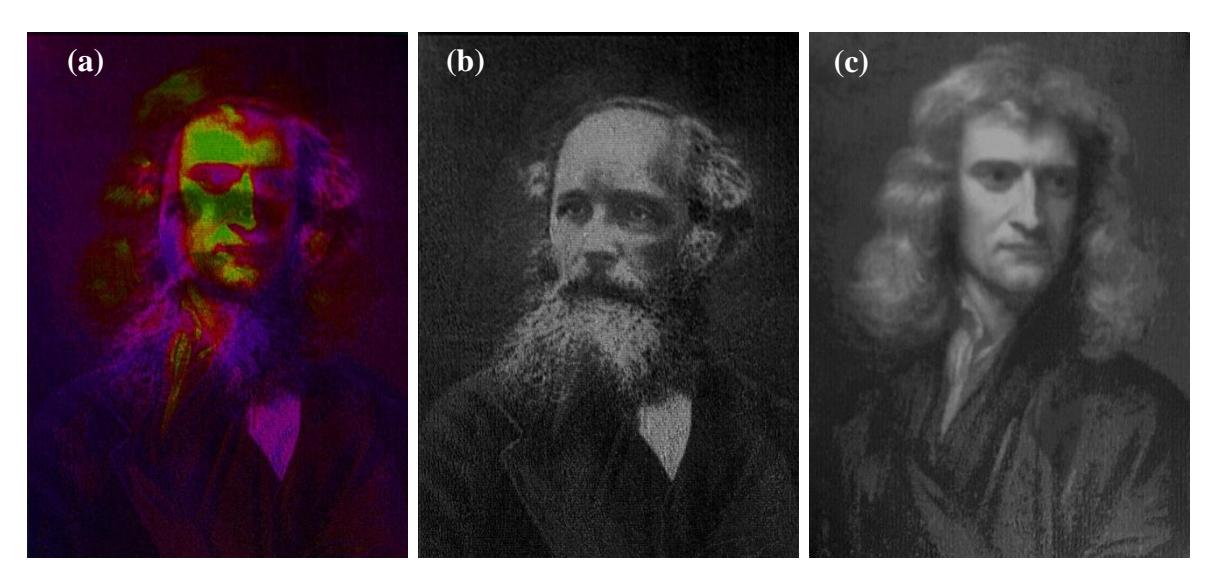
The optimization of the birefringent optical memory performance was achieved by a set of experiments. First, the retardance dependence on the number of laser pulses was measured. It was found that this dependence can be approximated by a saturated exponential growth (Fig. 1). Next, the birefringence strength was investigated as a function of the pulse duration. Finally, as a demonstration, we recorded the portraits of two great scientists, Maxwell and Newton, in a piece of silica glass by continuously controlling exposure and polarization during the writing process (Fig.2). The Maxwell portrait was encoded with varying strength of birefringence and Newton's one by varying the slow-axis orientation. Later, using the Abrio system, we managed to decouple both images, clearly demonstrating the potential of the proposed information recording technique.
In summary, by exploiting the ability of femtosecond lasers to create anisotropic modifications inside silica glass, a five-dimensional optical recording and reading has been demonstrated. The described memory multiplexing technique by polarization encoding can be successfully applied for high capacity data storage (estimated capacity 300 Gbit/cm3).