
Tunable wavelength light pulses with less than 20 fs duration are required for ultrafast molecular dynamics experiment, for example coherent 2D spectroscopy [1]. Such octave wide tunable pulses can be generated at up to 1 MHz repetition rates by a noncollinear optical parametric amplifier (NOPA) pumped by the third harmonic of an Ytterbium laser system [2].
Typical NOPA design employs: white light generator (WLG), an optical parametric amplifier and a pulse compressor. Classical pulse compressor based on a pair of prisms is insufficient in <20 fs regime due to residual third-order dispersion. Other methods are necessary for high-order dispersion compensation of NOPA optical components. Computer programmable pulse shapers based on acousto-optic modulator or liquid crystal mask, which is placed in the Fourier plane of 4f optical systems, allow one to manipulate the phase of the individual frequency components, which permits to compensate complex phase distortions. A simpler alternative of adaptive pulse shapers is 4f optical line with passive phase mask. Such system was developed in commercial NOPA for Ti:Sapphire laser systems – *TOPAS-white* [3] and allows generation of tunable wavelength pulses with duration down to 10 fs. The majority of losses in a pulse shaping apparatus are due to the dispersive element, typically a grating. Energy losses have to be reduced in order to use pulse shaper in the high repetition rate NOPA.
In this contribution we present results on numerical modeling of negative dispersion 4f pulse phase shaper consisting of a prism (near Brewster) as the dispersive element and passive phase mask, which is placed in the Fourier plane. A simplified setup of the pulse shaper model is shown in Fig. 1. A phase mask, which we use in our model, is thin, transparent glass plate with a curvature as a function of the spatial coordinate. Group delay of each frequency component is predefined by a refraction angle in the Fourier plane and the path length in the second prism. Spatial dispersion after the second prism is compensated by double pass through the optical system.
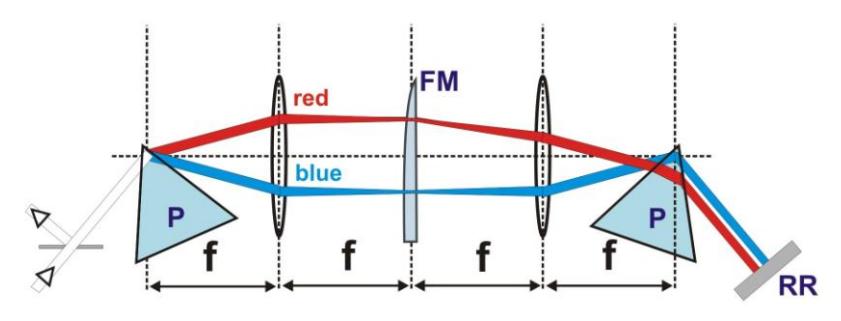
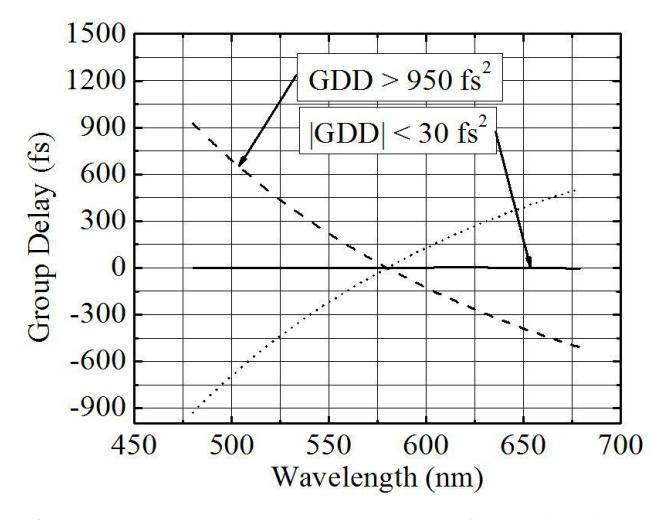
The phase mask surface curvature has been estimated using ray tracing technique. We have calculated optical path length and group delay for each frequency component, which is passes all optical system of NOPA, which consists of a WLG crystal plate, pulse shaper, crystals in amplifier and compressor based on material dispersion. Result of the group delay calculation is shown in Fig. 2. Our 3D model of pulse shaper is folded in to a compact 4f configuration with single SF10 prism, spherical mirror instead of the lens and a flat folding mirror in the Fourier plane. The phase mask is positioned in front of the folding mirror.
The upcoming work is to check newly designed pulse shaper experimentally with a NOPA pumped by the third harmonic of an Yb:KGW femtosecond laser (PHAROS, Light conversion Ltd.).