
Aromatic derivative containing heteroatoms – pyridine – is well known as a model compound for simulations of adsorption on metal surface. Quantum chemical modeling of adsorption processes includes several significant factors: i) ground state geometry simulation; ii) intermolecular electron transfer simulation.
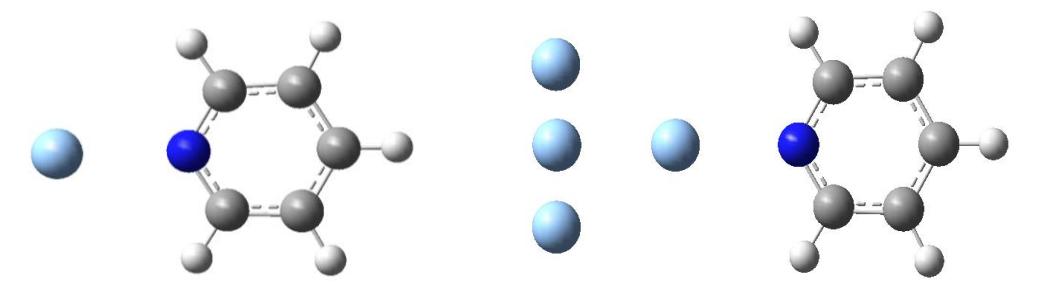
This work is devoted to exact quantum chemical study of intermolecular electron transfer (IET) between donor (pyridine) and acceptor (Ag surface). Ref. [1] (containing different geometry optimization tasks as well as excitation energy distribution tasks) allows us to take attention to the IET processes between pyridine and neighboring Ag atoms. Fig. 1 shows two structures which were used for IET simulation.
DALTON2 package was used for vector generation in the molecular orbital (MO) framework using linear combination of atomic orbitals (AO). Density functional (DFT) method CAMB3LYP ($\alpha$=0.190, $\beta$=0.460, $\mu$=0.330) by means of the effective core potential basis set ecp-sdd-DZ was used for such purposes. Following simulation of intermolecular electron transfer (IET) was done using NUVOLA package [2]. Results of simulation allow us to discuss the role of p*- and d*-electrons.