
Multi-Photon Polymerization (MPP) is a promising direct laser writing technique which has progressed rapidly during the past decade. This technique is based on tightly focused ultrashort pulses initiating radical polymerization reaction in a spatially confined region of a pre-polymer material. By selective exposure one can create a desirable form polymeric structure which is insoluble in organic developer. The MPP technique allows fabrication of true three-dimensional (3D) structures with no geometrical restrictions [1], as well as to reaching the sub-diffraction resolution up to tens of nanometers [2]. Due to these reasons, the MPP is distinguished among the other high spatial resolution fabrication techniques such as UV [3] and electron beam [4] lithographies, self-organization [5], ink-jet printing [6]. MPP has already established its applications in photonics [7], microoptics [8] and microfluidics [9] as well as biological [10] applications.
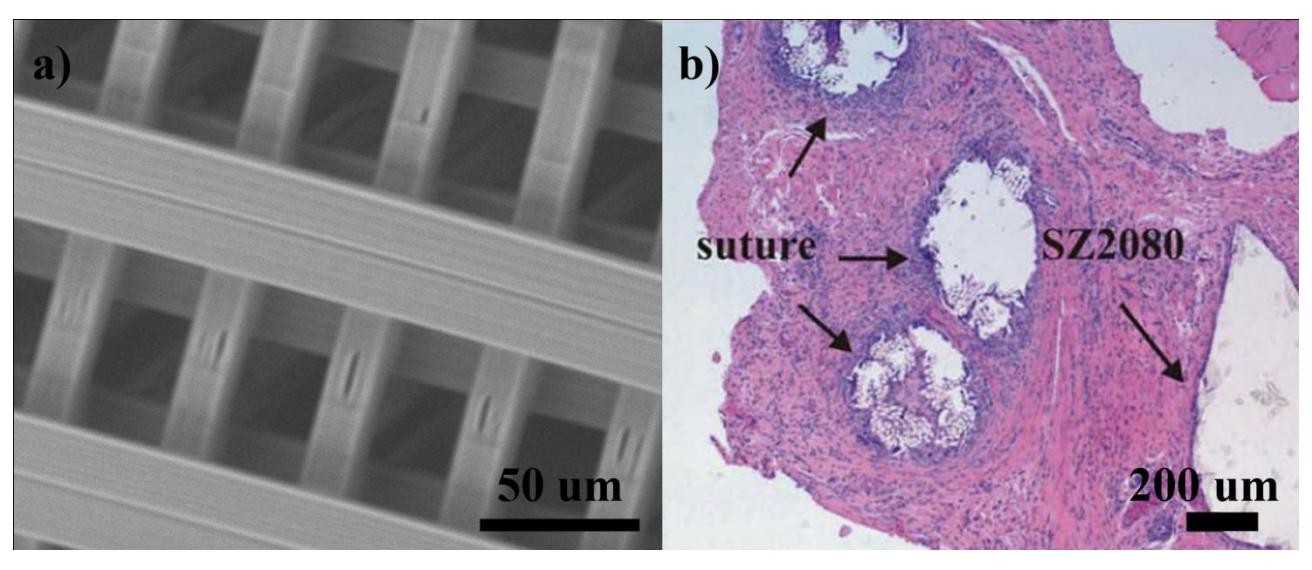
In this work we present latest results on MPP application for biomedicine, by fabrication of microstructured artificial 3D scaffolds for stem cell proliferation. Biocompatibility of non-microstructured polymers and scaffolds fabricated out of them by the MPP has been experimentally tested. Adult myogenic stem cell proliferation tests show polymers as well as artificial 3D scaffolds fabricated from acrylate based AKRE, hybrid organic-inorganic ORMOCORE b59 and SZ2080 materials as well as biodegradable PEG-DA-258 photopolymer to be applicable for biomedical practice. All these materials have been found to be at least as biocompatible as glass or polystyrene surfaces for stem cells in vitro and as a surgical suture judging by results of histological examination of tissues surrounding polymer implants ex vivo. Laboratory animals were rats and rabbits and implantation period was up to 3 weeks. Adhesion of cells was also investigated and obtained results proved the photostructurable polymers to be promising for future works for production of biocompatible 3D scaffolds. Additional functionalization of structure surfaces is possible by covering or doping the materials with biological agents, drugs or nanoparticles. Within the limitation of our study, we conclude that the proposed direct laser writing technique offers rapid and flexible fabrication of biomedical components with required shape, pore size and general porosity. The applications could target biostable and biodegradable implants applied for bone or tissue replacement as well as drug delivery or release agents.