
Charge Extraction by Linearly Increasing Voltage (CELIV) is a widely used technique for studying charge carrier transport in semiconductors. Due to certain limitations of the latter technique photogenerated charge extraction (photo-CELIV) is preferred in new material studies. In this work we show that photo-CELIV transients are strongly dependent on experimental conditions such as the light intensity and absorption profile. With this in mind we introduce a correction factor, which extends previously derived CELIV equations [1] to allow carrier mobility to be estimated at various light intensities and photogeneration profiles. In addition, we demonstrated current saturation dependence on recombination. Light absorption is accounted using Beer-Lambert law.
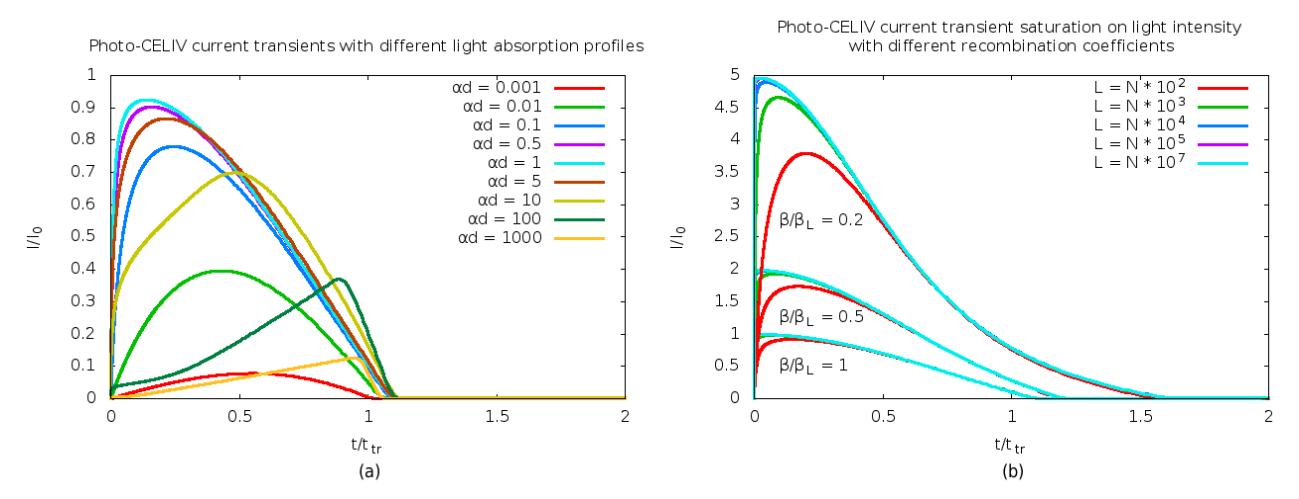
The results are shown in the following figures.
Results shown in figure 1.(b) are yet to be empirically proven. Clearly visible that extraction current saturates at certain value which corresponds to $\beta/\beta_L$. We expect that these results will help to experimentally determine bimolecular recombination coefficient.
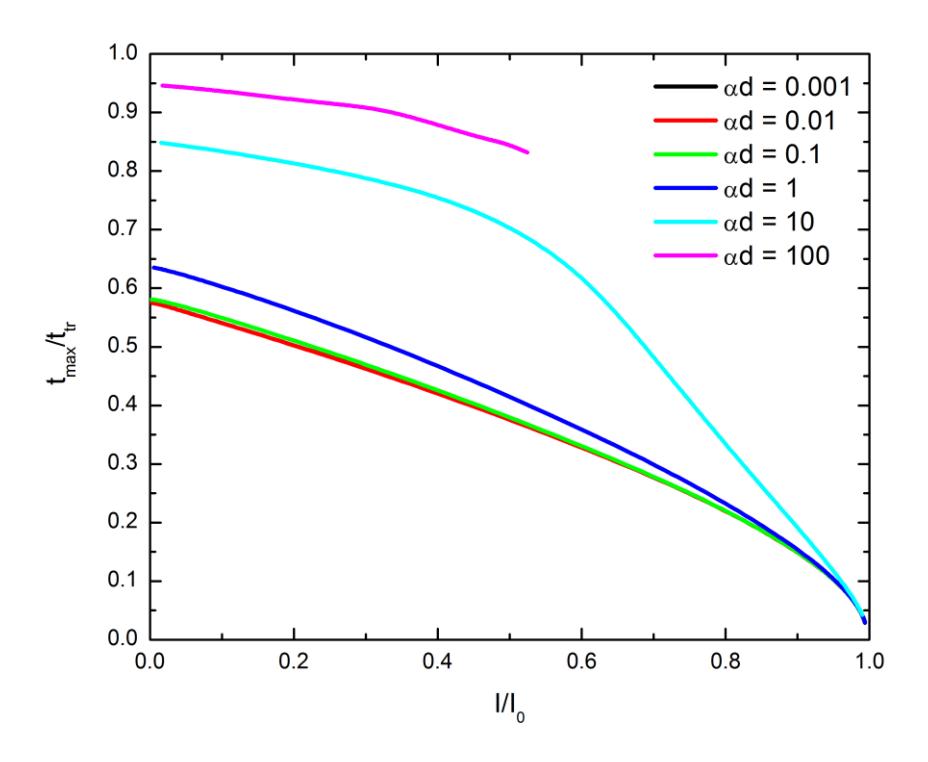
In figure 1.(a) current transient maximum time $t_{max}$ varies when absorption profile changes. Therefore the correction factor $K = t_{max}/t_{tr}$ (fig. 2) is used to calculate the charge carrier mobility using equation $\mu = K^2 \frac{2d^2}{At_{max}}$ at given experimental conditions. These results will be used in application of photo-CELIV.