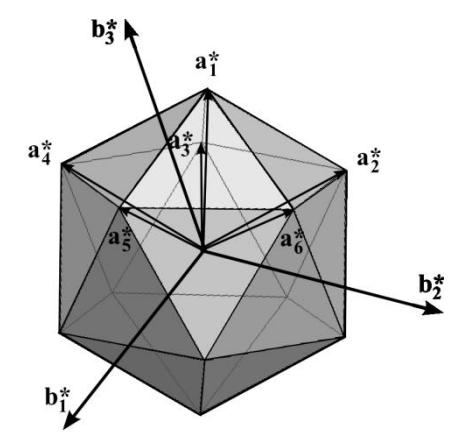
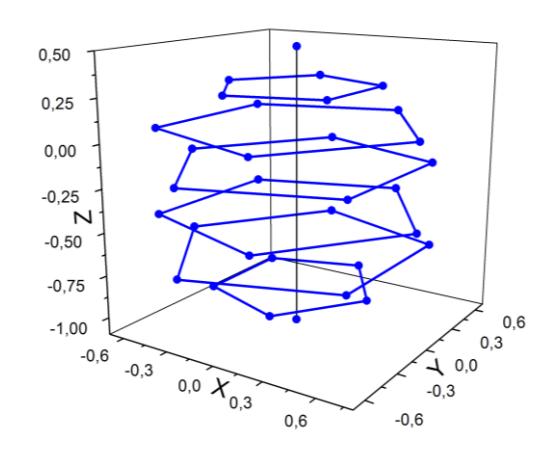
Amman tiling is a 3D generalization of the Penrose tiling. It reveals an icosahedral symmetry, thus it can be used as a quasilattice for building a model of an icosahedral quasicrystal (Fig. 1.). One can generate the set of points of the Amman tiling by projecting a 6D hypercubic lattice via 3D window - the so called atomic surface. In case of the Ammnan tiling the atomic surface has the shape of a rhombic triacontahedron (Fig. 2.).
I present a derivation of the structure factor of the Amman tiling on the basis of the average unit cell concept, which allows a structure factor calculation in 3D physical space only.
Any point of the Amman tiling can be written in the so called reference lattice. The position distribution of Amman tiling points is called an average unit cell. One can show that that there is a linear relation between the shape of the distribution $P$ and the shape of the atomic surface. A structure factor can be calculated as a Fourier transform of this distribution.