GENERATION OF 1/fβ NOISE USING THE SUPERPOSITION OF PROCESSES WITH TWO RELAXATIONS
R. Kazakevičius1, B. Kaulakys1
1 Institute of Theoretical Physics and Astronomy, Vilnius University, Goštauto 12, LT-01108 Vilnius, Lithuania
A random process characterized in some frequency range by the power spectral density proportional to $1/f^{\beta}$ is called "$1/f^{\beta}$ noise", where $\beta$ is real number between 0 and 2. Such processes have been observed in various areas. For example, $1/f^{\beta}$ noise plays an important role in electronic oscillators noise spectra [1]-[3]. The variability of biological rhythms generated by diverse functions in the human organism has revealed the persistent long-range correlation, or $1/f^{\beta}$ noise [4].
Many methods have been developed for generating process sequences with power spectral densities approximating $1/f^{\beta}$ over the given frequency range, such as wavelet-based methods [5], fractional integration-based methods [6], the fractional Brownian motion method [7], Fourier transform based-methods [8], Point process model [9] and other methods.
We analyzed the model based on signal I(t) that was a superposition of uncorrelated processes with two relaxations,
$$\tag{1}I(t) = \sum_{l=1}^{N} z_l(t).$$
Here N is a number of processes and $z_l(t)$ is a process with two relaxations. It is described by the differential equation
Model generated power spectral density as a function of frequency is represented
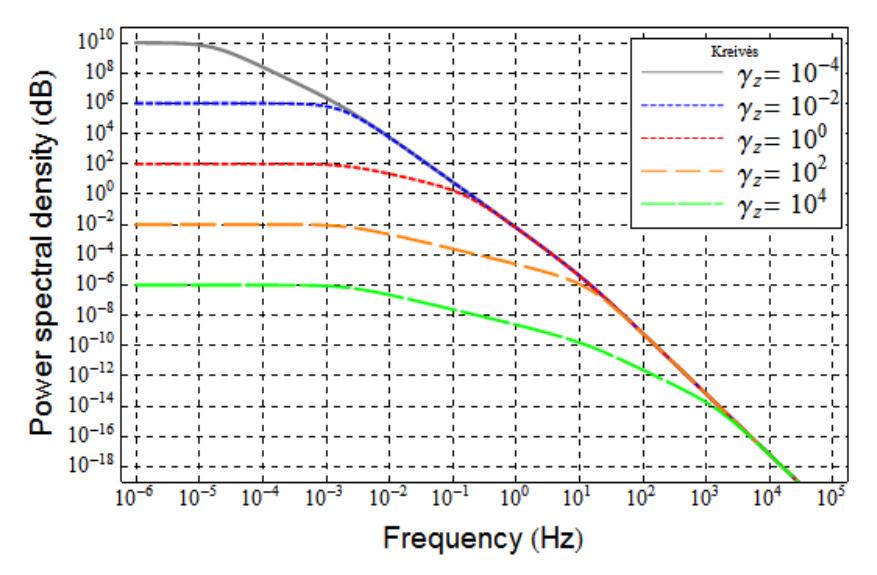
Fig. 1. Power spectral densities generated by Eq. (4), each spectral density are generated with different γz other parameters γmin = 0.01, γmax = 100, A = 0.5
. We proved that the model of superposition of processes with two relaxations in specific frequency ranges $\gamma_{min} \ll f \ll \gamma_{max} \ll \gamma_z$ and $\gamma_{min} \ll f \ll \gamma_z \ll \gamma_{max}$ generated power spectral density proportional to $1/f^{\beta}$. Here $\gamma_{min}$ and $\gamma_{max}$ are minimal and maximal values of the Brownian particle relaxation rates.
[1] J. Mukherjee, P. Robin, and S. Akhtar, An analytic circuit-based model for white and flicker phase noise in LC oscillators, IEEE Trans.Circuits Syst. I, Reg. Papers, 1584–1598 ( 2007).
[2] P. Maffezzoni, Frequency-shift induced by colored noise in nonlinear oscillators, IEEE Trans. Circuits Syst. II, Exp. Briefs, 887–891, 2007).
[3] P. Andreani, Time-variant analysis of the 1/f2 phase noise in CMOS parallel LC-tank quadrature oscillators, IEEE Trans. Circuits Syst. I, Reg. Papers, 1749–1760 (2006).
[4] K. Torre, D. Delignières, Unraveling the finding of 1/fβ noise in self-paced and synchronized tapping: a unifying mechanistic model, Biological Cybernetics, 159–170 (2008).
[5] G. W. Wornell, Wavelet-based representations for 1/f2 family offractal processes, Proc. IEEE, 1428-1450 (1993).
[6] J. A. Barnes and D. W. Allan, A statistical model of flicker noise, Proc. IEEE, 176–178 (1966).
[7] B. B. Mandelbrot and H. W. Van Ness, Fractional Brownian motions,fractional noises and applications, SIAM Rev., 422-436, (1968).
[8] A. V. Chechkin and V. Y. Gonchar, Fractional Brownian motion based on fractional integration of a white noise, Chaos, Solitons, Fractals, 391–398 (2001).
[9] B. Kaulakys, V. Gontis, and M. Alaburda, Point process model of 1/f noise vs a sum of Lorentzians, Phys. Rev. E71 (5) 051105 (2005).